Ayurvedic Lifestyle
 Read Article
Psoriasis Diet: Foods to Eat and Avoid, Explained by an Ayurvedic Doctor
Ayurvedic Lifestyle
Sciatica describes where your pain is, not what is causing it. Dr. Amita Abrol explains how to tell nerve pain from a muscle strain, the four warning signs that need same-day care, and how Ayurveda reads sciatica as Gridhrasi.
Personally supervised by Dr. Amita Abrol
Gold Medalist BAMS · MS Gynaecology & Obstetrics · 14+ years experience
Most people who arrive at the clinic with leg pain have already been told it is “just muscular.” They have tried a heat pack and a course of painkillers, felt better for a day or two, and then the same pain came back. The pattern repeats because the original problem was never in the muscle.
Sciatica is one of the most misunderstood words in back care. It describes where your pain travels — along the path of the sciatic nerve — but it does not tell you what is pressing on that nerve, and the second question is the one that decides treatment. This guide explains how to tell true nerve pain from a muscle strain, the four warning signs that need same-day hospital care, and how Ayurveda understands sciatica as Gridhrasi.
You can often spot sciatic pain by watching someone sit down. A person with ordinary back pain lowers themselves evenly into a chair. A person with sciatica tilts, shifts their weight onto the good side, and lets the painful leg slide out sideways.
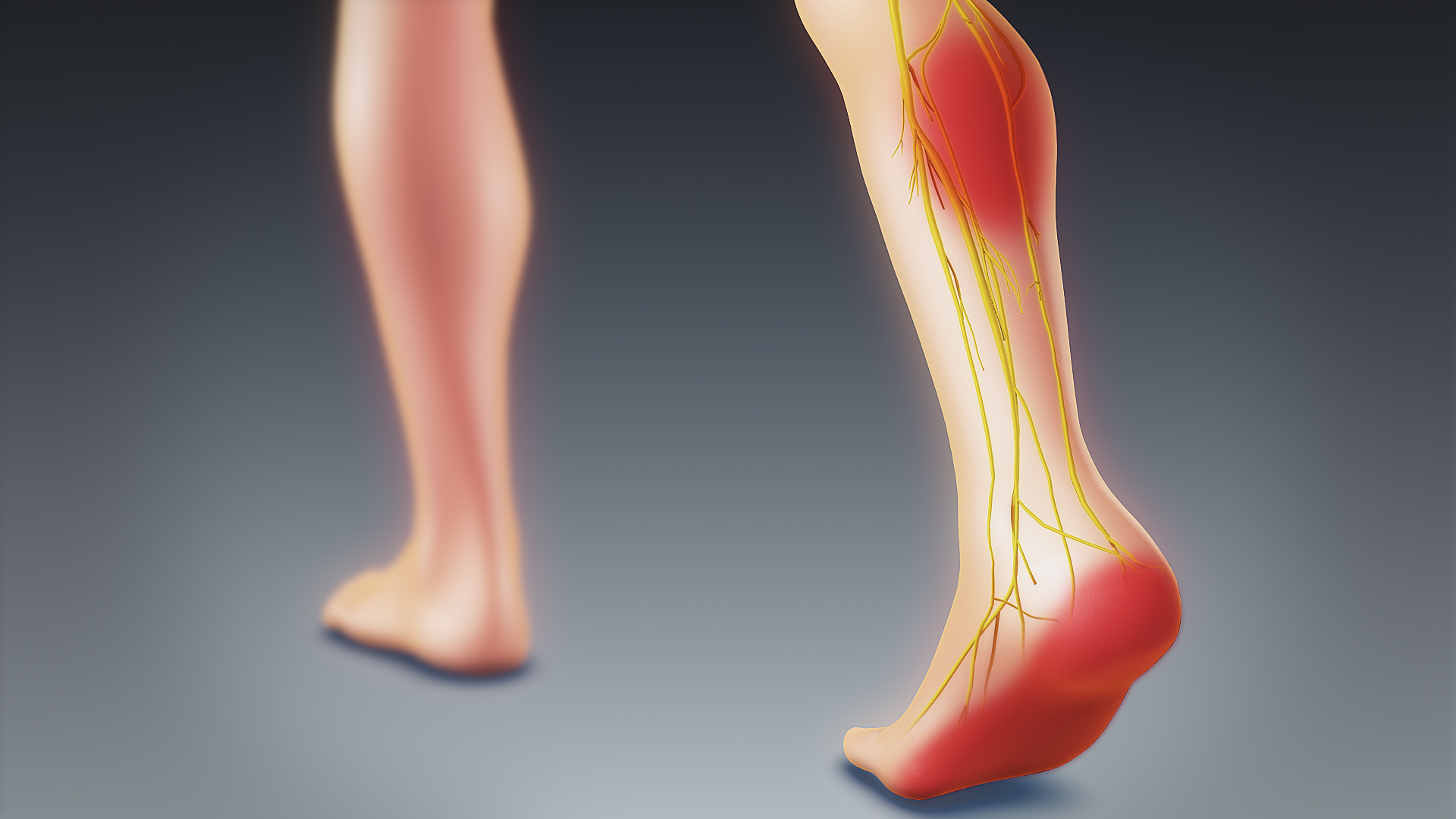
The sciatic nerve is the thickest nerve in the body — up to 2 cm wide. It is formed by nerve roots leaving the lower spine between the L4 and S3 levels, runs deep through the buttock, travels down the back of the thigh, and divides just below the knee to supply the calf, ankle and foot. Irritation or compression anywhere along that route can produce sciatic symptoms.
This is why “sciatica” on its own is an incomplete answer. A disc pressing on a nerve root and a tight buttock muscle can feel similar to the patient, but they are treated very differently. When a disc is the cause, a focused therapy such as Kati Basti over the lower back is usually appropriate; a muscular cause needs another approach entirely.
Some articles call sciatica “also known as piriformis syndrome.” That is misleading. The piriformis is a deep buttock muscle that lies over the sciatic nerve, and in some people the nerve passes straight through it. If the muscle tightens it can squeeze the nerve — but this is only one possible cause among several, not the main one. Disc problems and spinal narrowing account for far more cases, which is why months of dedicated glute stretching often change nothing.
This is the single most useful clue. Nerve pain follows the nerve: it usually starts in the lower back or buttock, runs down the back or outer thigh, crosses the knee and often reaches the calf or foot. Pain that stops above the knee can still be nerve-related, but it is less specific.
Sciatica almost always affects a single leg. Pain or numbness in both legs is unusual and needs prompt assessment — the reason is in the red-flags section below.
People with true sciatica rarely call it an “ache.” They say burning, shooting, electric, like a current running down the leg, or a deep pulling sensation. Muscular pain gets different words: sore, heavy, tight. The vocabulary itself is a diagnostic clue.
A hard cough or sneeze briefly raises the pressure inside the spinal canal. If disc material is touching a nerve root, that pressure spike travels straight down the leg as a jolt. This points to a spinal cause rather than a muscular one.
This surprises many people. Sitting should feel restful, but with disc-related sciatica it usually makes things worse, because sitting loads the lower discs more than standing does. Patients often say they can manage a 20-minute walk but cannot sit through a meal.
Pins and needles in the calf or foot, a patch of skin that feels dull to touch, or a leg that takes effort to lift all point to genuine nerve involvement rather than irritation of the tissue around it.
| Feature | True sciatica (nerve root) | Piriformis syndrome | Muscular back pain | Hip joint problem |
|---|---|---|---|---|
| Pain origin | Lower back or buttock | Deep buttock | Lower back only | Groin, front of hip |
| Where it travels | Below the knee, often to the foot | Buttock to back of thigh, rarely past the knee | Stays in the back | Groin to front of thigh |
| Pain quality | Burning, shooting, electric | Deep ache, cramping | Sore, stiff, heavy | Deep, grinding |
| Worse with cough or sneeze | Yes, often sharply | No | No | No |
| Worse when sitting | Usually yes | Yes, especially hard seats | Often better sitting | Worse standing or walking |
| Numbness or tingling | Common | Sometimes | Rare | Rare |
| Straight-leg-raise test | Reproduces the leg pain | Often normal | Usually normal | Usually normal |
| Worse climbing stairs | Variable | Sometimes | Sometimes | Yes, typically |
This table helps you understand your symptoms; it cannot replace an examination. Many people have more than one of these problems at once, which only a clinical assessment can separate.
Four uncommon symptoms turn sciatica into a surgical emergency. Rarely, the bundle of nerves at the base of the spine — the cauda equina — becomes compressed, and a delay of even a day can cause permanent loss of bladder, bowel and sexual function.
Go to an emergency department immediately if you have:
Do not book an appointment, try a home remedy, or wait for morning. This needs an urgent MRI and a surgical opinion.
Nerves do not become irritated for no reason. Something has to act on them.
The discs between the vertebrae work as cushions. When the tough outer ring weakens, the softer centre can bulge and press on a nerve root. This is the most common cause, and it explains the cough-and-sneeze reaction.
With age, bone and ligament thicken and reduce the space the nerves pass through. It mostly affects people over 50. The giveaway pattern is pain that eases when sitting or leaning forward and builds when standing or walking for long.
One spinal bone shifts forward over the one below and narrows the exit space for the nerve. It often starts as lower back pain, with leg symptoms coming later.
More likely in people who sit for long hours, drive for a living, or have just started intense hip work at the gym.
The growing uterus, the change in posture and hormone-related loosening of the pelvic ligaments can combine to irritate the nerve. It usually settles after delivery.
Years of high blood sugar damage nerves directly. This is not compression, but it produces burning and numbness in the leg that can look just like it — and it needs completely different treatment. If you have diabetes and a new leg symptom, say so at the start of the consultation.
Lifting heavy loads with a bent spine, long driving shifts, whole-body vibration and hours of uninterrupted sitting are all well-established contributors. Stiffness in the neck and upper back at the same time is worth mentioning too.
Published figures vary a lot, and the reason matters. Standard references put the lifetime chance of sciatica somewhere between 10% and 40%, with 1–5% of people having an episode in any given year. It peaks in the thirties and is rare before age 20 without a prior injury.
That wide range reflects disagreement about how strictly “sciatica” is defined. Under stricter criteria, a large Finnish study found a lifetime prevalence of 5.3% in men and 3.7% in women, and sciatica makes up fewer than 5% of low-back-pain visits in primary care. In other words: sciatica is common, but nowhere near as common as the number of people who assume their back pain is sciatica. Most back pain does not involve the nerve at all.
Classical Ayurvedic texts call this condition Gridhrasi, from gridhra, the vulture — a reference to the stooped, dragging walk that severe sciatica produces. Charaka lists Gridhrasi among the Vataja Nanatmaja Vyadhi, disorders driven mainly by disturbed Vata. Since Vata governs movement and nerve function, and shows itself as pain, stiffness, dryness and erratic sensation, nerve pain fits the description almost exactly.
Charaka describes Gridhrasi in two forms, and the distinction changes treatment.
Vataja Gridhrasi presents with ruk (pain), toda (a stabbing, pricking quality), stambha (stiffness) and muhurspandana (intermittent twitching). The pain begins at the sphik (buttock) and moves through the kati (lower back), uru (thigh), janu (knee), jangha (calf) and pada (foot). That sequence follows the path of the sciatic nerve with striking accuracy — described centuries before anatomical dissection.
Vata-Kaphaja Gridhrasi has all of the above plus tandra (drowsiness, heaviness), gaurava (a weighted-limb feeling) and aruchi (poor appetite, sluggish digestion). Vagbhata adds sakthi-utkshepa-nigraha — difficulty lifting the affected leg.
Why this matters: a pure-Vata picture is dry, sharp and unpredictable, worse in cold weather and at night, and responds to warmth, oil and nourishing therapy. A Vata-Kapha picture is duller and heavier, usually with slow digestion and a sedentary routine. Starting rich oil therapies in the second type can increase the heaviness before it helps — here the digestion and Kapha need attention first. The same leg pain, opposite first moves.
This needs an in-person assessment, including Nadi Pariksha (pulse examination) where appropriate. Both types share the same leg pain; what separates them is digestive capacity, the character of the heaviness and the pulse. The assessment takes about twenty minutes and decides the direction of treatment — oils first or Kapha first, which therapies, and in what order.
Strict bed rest is out of date. Long spells of lying down stiffen the back and weaken the muscles that support the spine. Gentle movement within the limits of pain does better. Short walks, frequent changes of position, and avoiding long unbroken stretches of sitting are the foundation. Desk workers benefit more from standing and moving for 60 seconds every half hour than from almost any formal exercise.
Treatment works on three fronts at once: the Vata disturbance, the local stiffness and inflammation, and digestion — because weak digestion produces metabolic residue (ama) that is understood to block the channels and aggravate Vata. Commonly used therapies include:
Internal medicines are chosen case by case rather than issued as a fixed package. Sequence, duration and selection depend on the cause of compression, the Gridhrasi type, digestive strength and constitution. No single protocol suits everyone — be wary of any clinic selling an identical package to every patient. You can read more about Ayurvedic sciatica treatment in Amritsar.
Many people move from months of disability back to full function, but some presentations need other care. Progressive nerve weakness needs a surgical opinion. A large disc fragment pressing hard on a root may not settle with conservative treatment. Cauda equina symptoms need surgery, not therapy. A responsible practitioner will say when to refer.
Almost everyone asks for a timeline, and the honest answer is longer than most people are told. Many episodes improve over weeks to months, but the long-term data is sobering. A systematic review found about 30% of people still had troublesome symptoms at one year, and 5–15% eventually needed surgery. One group reported 55% still symptomatic at two years and 53% at four years — including people who recovered by year two and relapsed by year four. Once sciatica lasts beyond about twelve weeks or starts to recur, it tends to respond less well to treatment.
Two things follow from that. First, act early — the most treatable window is the first few weeks, not month eleven after a year on painkillers. Second, distrust guarantees. Given how often it recurs, no system of medicine can honestly promise a permanent cure. A realistic goal is a large drop in pain, reliable movement, and recurrences that are milder and further apart.
Beyond the emergency signs above, get assessed if:
Ask for a physical examination, not just a scan review. Imaging and symptoms often disagree — plenty of people have disc bulges on MRI and no pain at all. The examination is what connects the scan to the person in front of you. Bringing a recent MRI or X-ray report to the appointment helps.
Sciatica tells you where your pain is, not why. The useful question is what is pressing on the nerve and what is driving that. Pain that runs below the knee, spikes when you cough, and comes with tingling or weakness means the nerve is involved and deserves a proper examination rather than another course of painkillers. Learn the four emergency signs even though you will probably never need them. Ayurveda offers a detailed framework that separates presentations instead of treating them all the same — it helps many people, and it does not replace a surgical opinion when one is needed.
Hero image: 3D medical illustration of sciatic nerve pain by ScientificAnimations.com, used under CC BY-SA 4.0.
Medical disclaimer: This article is for education and does not replace an individual consultation. Speak to a qualified practitioner before starting any treatment. Any of the emergency symptoms described above needs immediate hospital attention.
Have questions about your own symptoms?
Every case is different. Book a consultation with Dr. Abrol for a treatment plan personalised to your Prakriti and health history.
Get a personalised Ayurvedic treatment plan from Dr. Abrol - in clinic or online.
Dr. Amita Abrol
Gold Medalist BAMS, MS Gynaecology
Book a clinic visit or online consultation with Dr. Abrol, based on what you've just read.