
Women's Health
Hypothyroidism in Ayurveda: Why Your Reports Are Normal But Your Body Isn't
You are tired, cold and gaining weight - but your thyroid report reads normal. Dr. Amita Abrol explains the four reasons reports miss what your body already knows, how Ayurveda reads hypothyroidism as weak Dhatvagni, and what treatment realistically achieves.
- Published September 10, 2026
- 13 minutes read
- Medically reviewed
- By Dr. Amita Abrol

Personally supervised by Dr. Amita Abrol
Gold Medalist BAMS · MS Gynaecology & Obstetrics · 14+ years experience
Key takeaways
- About 1 in 10 Indian adults has hypothyroidism, and roughly one third of them do not know it.
- A 'normal' TSH is a wide statistical range (0.4-4.0 mIU/L) - feeling well at 1.5 and unwell at 3.9 is common and real.
- Most labs test TSH alone, which can miss low Free T3, raised anti-TPO antibodies and nutrient gaps.
- Ayurveda calls this pattern Dhatvagni Mandya - the metabolic fire inside your tissues has dimmed, so hormone reaches the blood but cannot act in the cell.
- Ashwagandha has randomised trial evidence in subclinical hypothyroidism; most other herbs rest on traditional use rather than trial data.
- Never stop or reduce levothyroxine on your own. Ayurveda works best alongside it, and pregnancy always needs medical management.
In This Article
- You Are Not Imagining It
- Hypothyroidism in India: The Real Numbers
- Why Your Reports Can Be “Normal” While You Are Not
- How Ayurveda Reads the Same Problem
- Modern Medicine vs Ayurveda: An Honest Comparison
- What Ayurvedic Treatment Actually Involves
- If You Are Already Taking Levothyroxine — Read This
- What This Looks Like in Practice
- Being Honest About Limits
- Why This Matters Especially for Women
- Key Points
- References
Quick answer: Ayurveda treats hypothyroidism as a problem of weak digestive fire (agni), not just a low hormone number. When Kapha and Meda (fat tissue) build up, metabolism slows at the cell level. This is why you can feel tired, cold, heavy and low even when your TSH report reads “normal.” Treatment focuses on rekindling agni, clearing blockage through Panchakarma, and using herbs such as Ashwagandha and Kanchanar Guggulu — alongside, not instead of, your prescribed medicine.
You Are Not Imagining It
You are tired the moment you wake up. Your hair is thinning in the shower drain. You have gained six kilos without changing anything. Your hands and feet stay cold. Your mood feels flat.
So you get tested. And the report says normal.
You are told to sleep more. Or to stress less. Or that this is simply age.
If this is you, please know two things. First, you are not imagining it. Second, you are not alone — this exact gap between test results and lived experience is one of the most common things we see in clinic.
This article explains why that gap exists. It looks at the science of thyroid testing honestly. Then it explains how Ayurveda reads the same problem through a very different lens — and what that lens allows us to do.
Hypothyroidism in India: The Real Numbers
The thyroid is a small butterfly-shaped gland at the base of your neck. It sets the speed of almost every cell in your body. When it slows down, everything slows down.
Here is how common that is in India:
- A landmark eight-city study published in the Indian Journal of Endocrinology and Metabolism found hypothyroidism in 10.95% of adults — roughly 1 in 10.
- Around one-third of those cases were undiagnosed at the time of testing.
- Women are affected far more often than men — by most estimates 8 to 10 times more.
- Subclinical hypothyroidism, where TSH is raised but T4 is still normal, affects a further 8–9% of Indian adults.
- Risk rises sharply after age 35, and again around perimenopause.
Inland northern India, including Punjab, has historically been part of the country’s goitre belt. Salt iodisation has helped enormously. But iodine is no longer the main driver. Today the most common cause of hypothyroidism in iodine-sufficient areas is Hashimoto’s thyroiditis — an autoimmune condition where the body’s own immune system slowly attacks the thyroid.
That distinction matters more than most people realise. We will come back to it.
Why Your Reports Can Be “Normal” While You Are Not
This is the heart of the problem. There are four honest reasons.
1. “Normal” Is a Very Wide Range
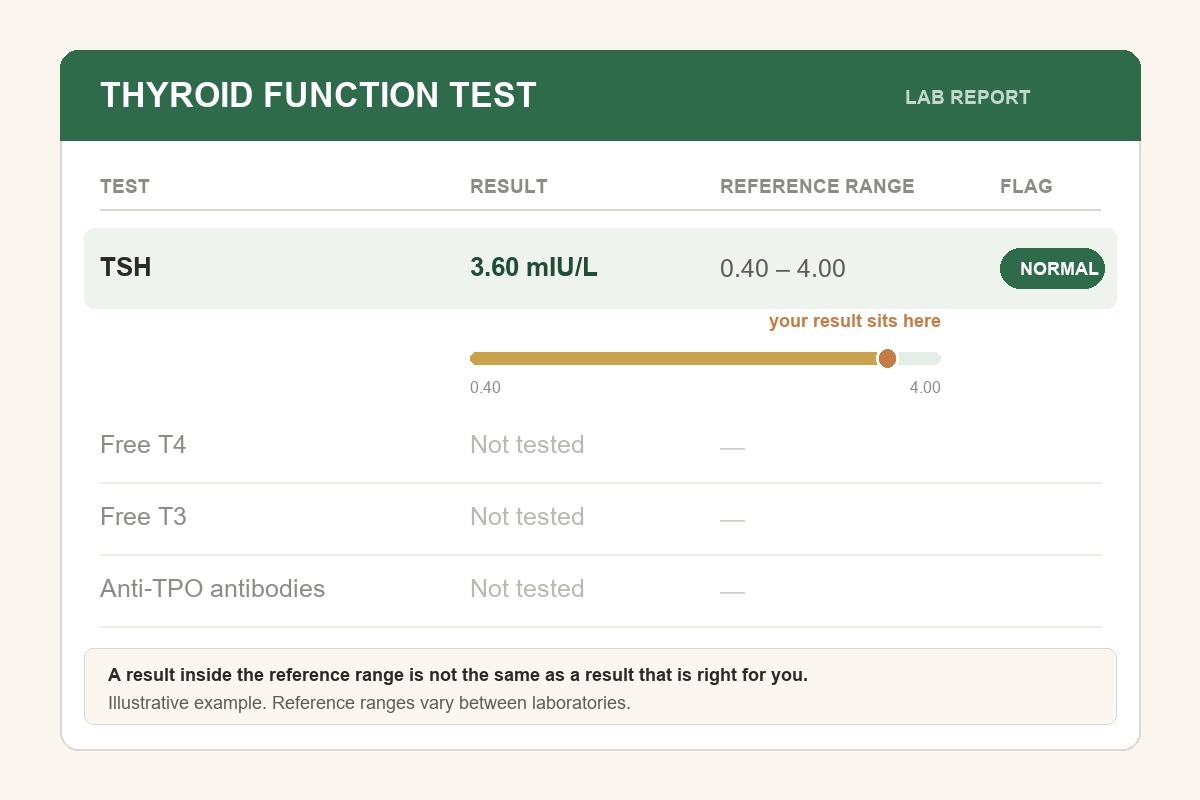
Most Indian labs report a TSH reference range of roughly 0.4 to 4.0 mIU/L.
That range is not a health target. It is a statistical range — it describes where most people in a test population fell. It was never designed to define where you personally feel your best.
Think of shoe sizes. Sizes 5 to 11 are all “normal” sizes. That does not mean any of them will fit you.
Many people feel well with a TSH between 1.0 and 2.0. The same person at 3.8 may feel exhausted, foggy and cold — and still be told their report is fine. Both readings sit inside the same “normal” band.
There is genuine ongoing debate in endocrinology about whether the upper limit should be lowered to around 2.5 mIU/L. That debate is not settled. But it tells you something important: the boundary is a judgement call, not a law of nature.
2. Most Labs Test Only One Number
A basic thyroid test measures TSH alone. TSH is not a thyroid hormone. It is the pituitary’s instruction to the thyroid — a message, not the result.
Here is what a fuller picture includes:
| Test | What it actually tells you | Usually included? |
|---|---|---|
| TSH | How hard your brain is pushing the thyroid | Almost always |
| Free T4 | The main hormone your thyroid releases (storage form) | Sometimes |
| Free T3 | The active hormone your cells actually use | Rarely |
| Anti-TPO antibodies | Whether your immune system is attacking the thyroid (Hashimoto’s) | Rarely |
| Reverse T3 | Whether stress or illness is blocking hormone conversion | Almost never |
| Ferritin, Vitamin D, B12 | Nutrients needed to make and use thyroid hormone | Rarely |
You can have normal TSH and normal T4, but low Free T3 — meaning your body is making hormone but not converting it into the usable form. Your report looks fine. Your cells are still starved.
3. Antibodies Come Years Before the Numbers Move
In Hashimoto’s, anti-TPO antibodies can be raised for 5 to 10 years before TSH ever rises above range.
During those years the thyroid is under slow attack. It compensates. It keeps output normal — but at a cost. Symptoms fluctuate. Some days are fine, others are not.
If nobody ever tests antibodies, this entire window is invisible. The patient is simply told, year after year, that the report is normal.
4. The Symptom May Not Be the Thyroid at All
This is the part that requires real honesty.
Fatigue, weight gain, hair fall and low mood are not exclusive to thyroid disease. They are also caused by iron deficiency, low vitamin D, low B12, poor sleep, PCOD, depression and chronic stress — all extremely common in Indian women.
Sometimes the report is normal because the thyroid genuinely is fine, and the real cause is somewhere else. A good clinician looks for that too. Blaming everything on the thyroid is its own kind of mistake.
How Ayurveda Reads the Same Problem
Ayurveda has no word for “thyroid.” The gland was not described as a separate organ in the classical texts.
But Ayurveda described the pattern with remarkable precision, thousands of years ago.
Galaganda: The Swelling in the Throat
Sushruta Samhita describes Galaganda — a swelling in the front of the neck. Charaka groups it under diseases of Kapha and Meda (fat tissue). This is the closest classical match to goitre.
But most hypothyroidism today involves no visible swelling at all. So Galaganda describes only part of what we see.
Dhatvagni Mandya: The Fire Inside Your Tissues
This is the concept that matters most.
Ayurveda teaches that digestion does not happen only in the stomach. Each of the seven body tissues (dhatus) has its own metabolic fire, called dhatvagni. This is the fire that converts nourishment into living tissue.
When dhatvagni weakens:
- Food is not fully converted. It turns into Ama — a sticky, undigested residue.
- Ama blocks the fine channels (srotas) that carry nutrients and hormones.
- The hormone may be present in the blood. But it cannot reach or act inside the cell.
Read that again, because it maps almost exactly onto the modern picture of poor T4-to-T3 conversion and cellular resistance.
This is why Ayurveda can explain a normal report with an unwell patient. The messenger arrived. The door was blocked.
The Three Patterns We See in Clinic
Not every hypothyroid patient is the same. Treatment changes based on which pattern dominates.
| Pattern | How it shows up | Typical patient | Treatment direction |
|---|---|---|---|
| Kapha–Medo type | Weight gain, heaviness, puffiness, excess sleep, slow speech, cold skin | Most common. Often post-pregnancy or after 35 | Reduce Kapha, dry excess Meda, strong agni work — Udvartana, dry heat, light diet |
| Vata-dominant type | Thin build, dry skin, constipation, anxiety, insomnia, joint pain, palpitations | Often older, or high-stress professionals | Nourish and calm — Abhyanga, Shirodhara, warm oily food, no harsh detox |
| Pitta–Ama type | Hair fall, acidity, irritability, heat intolerance, raised antibodies | Often autoimmune / Hashimoto’s | Cool the inflammation, clear Ama — Virechana, bitter herbs, stress work |
A Kapha-type patient given a Vata-type plan will feel worse. This is exactly why generic “thyroid churna” bought online so often fails — and occasionally causes harm.
Proper assessment starts with pulse diagnosis and constitutional analysis. If you have never had your prakriti assessed, that is where treatment should begin — not with a herb. See Nadi Pariksha and know your prakriti.
Modern Medicine vs Ayurveda: An Honest Comparison
Both systems have real strengths. Neither is complete alone.
| Modern Medicine | Ayurveda | |
|---|---|---|
| Main question asked | Is the hormone level low? | Why did metabolism slow down? |
| Main tool | Levothyroxine replacement | Agni correction, Panchakarma, herbs, diet |
| Speed of effect | Fast and reliable — weeks | Slower and gradual — 3 to 6 months |
| Strength | Precise, measurable, life-saving in severe cases | Addresses digestion, stress, weight and sleep together |
| Weakness | Does not address root cause or lifestyle | Slower, less standardised, weaker trial evidence |
| Best for | Overt hypothyroidism, pregnancy, very high TSH | Subclinical cases, lingering symptoms on medication, prevention |
| Handles autoimmunity? | Monitors it, does not usually treat it directly | Addresses inflammation, gut and stress load |
The practical answer for most patients is not “either/or.” It is both. Take the medicine that keeps you safe. Use Ayurveda to work on why the system slowed down in the first place.
What Ayurvedic Treatment Actually Involves
Let us be specific, and let us be honest about the level of evidence behind each part.
Herbs — And What the Research Really Shows
| Herb | Traditional use | Evidence status |
|---|---|---|
| Ashwagandha (Withania somnifera) | Rasayana; restores strength, calms Vata | Strongest. A 2018 randomised, double-blind, placebo-controlled trial in subclinical hypothyroidism found 600 mg/day of root extract over 8 weeks improved TSH, T3 and T4 versus placebo. Small study (n≈50), but real |
| Kanchanar Guggulu | Classical formula for glandular swellings (granthi, galaganda) | Long traditional use; limited modern trial data. Mostly clinical experience |
| Guggulu (Commiphora mukul) | Reduces Meda, moves Kapha | Animal studies show thyroid-stimulating activity. Human data limited |
| Punarnava (Boerhavia diffusa) | Reduces fluid retention and puffiness | Diuretic and anti-inflammatory activity documented |
| Triphala | Gentle daily Ama clearance | Good evidence for gut and metabolic support |
| Guduchi (Tinospora cordifolia) | Immune modulation | Useful where autoimmunity is present |
| Brahmi / Shankhpushpi | For brain fog and low mood | Cognitive support evidence is reasonable |
Two serious cautions. Guggul may interact with thyroid medication and with blood thinners. And Ashwagandha can push thyroid hormone up — helpful in hypothyroidism, but risky if you have Hashimoto’s with swinging phases, or hyperthyroidism. It is also generally avoided in pregnancy. See Is ashwagandha safe? for the full safety picture.
None of these should be self-prescribed. Dose, formulation and anupana (what you take it with) all change the effect.
Panchakarma — Chosen by Pattern, Not by Package
Panchakarma is not a spa treatment and not a one-size detox. For thyroid patients we most often use:
- Udvartana — a dry herbal powder massage that reduces Kapha and Meda. The single most useful therapy for the heavy, puffy, weight-gain pattern.
- Virechana — supervised therapeutic purgation to clear Pitta and Ama. Valuable where inflammation and antibodies are high.
- Abhyanga and Shirodhara — for the Vata pattern with anxiety, insomnia and dryness. Shirodhara is genuinely useful for the stress load that drives thyroid dysfunction.
- Nasya — medicated oil through the nose, traditionally indicated for disorders above the collarbone.
Timing matters. Aggressive detox during a Vata flare will worsen symptoms. This is why supervision is not optional.
Diet: Practical Rules That Actually Change Things
Forget complicated protocols. These few rules do most of the work.
Do this:
- Eat your largest meal at midday, when agni is naturally strongest.
- Start meals with a thin slice of fresh ginger with a pinch of rock salt to kindle digestion.
- Cook with warming spices: black pepper, ginger, cumin, turmeric, cinnamon.
- Eat food warm and freshly cooked. Leftovers and cold food increase Ama.
- Ensure enough protein, iron, selenium and zinc. Selenium in particular has evidence for lowering thyroid antibodies. Good sources: pumpkin seeds, sesame, lentils and eggs.
Limit this:
- Large amounts of raw cruciferous vegetables — raw cabbage, cauliflower, broccoli, kale. These contain goitrogens. Important nuance: cooking largely deactivates them, and normal cooked portions are fine for most people. Raw juices and daily raw salads are the real concern.
- Soy — not forbidden, but it interferes with medication absorption. Keep a four-hour gap.
- Heavy, cold, sweet, oily foods — the classic Kapha builders. Cheese, cold milk, refined sugar, fried snacks.
- Skipping meals and late dinners. Both weaken agni directly.

Yoga and Lifestyle
A six-month study on hypothyroid women found that regular yoga practice improved thyroid function and, in some participants, reduced the required thyroxine dose. Encouraging — though the study was small and needs replication.
Traditionally recommended postures work the throat region:
- Sarvangasana (shoulder stand) and Halasana (plough)
- Setu Bandhasana (bridge) and Matsyasana (fish)
- Ujjayi and Bhramari pranayama
Please note: shoulder stand and plough are not safe for everyone. Avoid them with cervical spine problems, high blood pressure, glaucoma, or during pregnancy and menstruation. Learn them from a qualified teacher. Bridge pose and Ujjayi breathing are far safer starting points.
Beyond posture, two things matter enormously and are almost always neglected: sleeping before 10.30 pm, and avoiding daytime naps — daytime sleep is specifically described as increasing Kapha.

If You Are Already Taking Levothyroxine — Read This
This section is the most important in the article.
Do not stop or reduce your thyroid medication on your own. Not for a week. Not to “test” whether Ayurveda is working.
Untreated or under-treated hypothyroidism carries real risks: high cholesterol, heart disease, infertility, depression, and in pregnancy, harm to the baby’s brain development. In severe untreated cases it can become life-threatening.
In pregnancy, thyroid requirements rise quickly and must be managed medically. Ayurveda supports; it does not replace.
Here is how to take your medicine properly — many people lose effectiveness simply through timing:
- Take it on an empty stomach, 45–60 minutes before breakfast.
- With plain water only. Not tea, not coffee, not milk.
- Keep a four-hour gap from calcium, iron and antacids.
- Keep a four-hour gap from Ayurvedic mineral formulations (bhasmas), which may contain calcium or iron.
- Be consistent. Same time, every day.
Always tell both your doctors what you are taking. Herb–drug interactions are real. A good Ayurvedic physician will want to see your reports and will coordinate, not compete.
The realistic goal for most patients is this: better symptom control, better weight and energy, a slower rise in dose over the years — and in some subclinical cases, avoiding medication altogether. Not a guaranteed cure.
What This Looks Like in Practice
A composite example, typical of what we see. Details changed for privacy.
A 34-year-old teacher from Amritsar came in after two years of feeling unwell. Weight up 9 kg. Hair falling. Constant cold. Periods had become irregular.
Her reports: TSH 3.6 — inside the normal range. She had been told, three times, that her thyroid was fine.
On assessment: a clear Kapha–Medo pattern with heavy Ama signs — thick tongue coating, sluggish digestion, heaviness after meals. We requested the tests nobody had ordered. Anti-TPO came back raised. Vitamin D was 14. Ferritin was 11.
Nothing had been “normal.” It had simply never been measured.
Her plan ran six months: Ama-clearing herbs first, then Udvartana and a supervised Virechana; corrected vitamin D and iron; midday-main-meal timing; a fixed sleep schedule; and Shirodhara for the stress load.
By month six: energy substantially better, 6 kg down, periods regular, antibodies lower. TSH 2.1.
Note carefully what happened here. Her original report was never “abnormal” by lab standards. What changed was that somebody looked at the whole picture — and treated the digestion, the nutrients and the stress, not just the number.
Being Honest About Limits
Good medicine means saying what a system cannot do.
| Ayurveda can genuinely help with | Ayurveda should not be relied on alone for |
|---|---|
| Subclinical hypothyroidism (borderline TSH) | Overt hypothyroidism with very high TSH |
| Symptoms that persist despite normal reports | Pregnancy — always needs medical management |
| Weight, digestion, sleep and energy | Post-surgical or post-radioiodine thyroid loss |
| Stress and autoimmune load | Congenital hypothyroidism in children |
| Reducing how fast the condition progresses | Any emergency or rapidly worsening symptoms |
Anyone promising to “cure your thyroid permanently” or telling you to stop your medication is not practising Ayurveda responsibly. Classical Ayurveda itself teaches the physician to distinguish between what is curable (sadhya) and what is manageable (yapya). Much of hypothyroidism is the second kind — and managing it well is a genuinely worthwhile goal.
Why This Matters Especially for Women
Thyroid problems rarely arrive alone. They travel with the conditions we treat most often.
Low thyroid function is a well-recognised cause of irregular periods, heavy bleeding and difficulty conceiving. It frequently coexists with PCOD, and it is a standard part of any infertility workup. It also shares metabolic ground with insulin resistance and diabetes.
If you are being treated for any of these and have never had a full thyroid panel, ask for one. And if you are being treated for the thyroid alone while cycles, weight and mood remain disturbed, the picture is probably wider than the thyroid.
Key Points
A normal report is not the same as a healthy body. The TSH range is wide, most labs test only one number, and antibodies can precede any change in that number by years. Ayurveda offers a framework — Dhatvagni Mandya — that explains exactly this gap: hormone present in the blood, blocked at the cell. That framework leads to practical work on digestion, sleep, stress and tissue metabolism, which is where most people actually feel the difference. It does not replace replacement hormone when replacement hormone is what you need. Used together, they cover far more ground than either does alone.
References
- Unnikrishnan AG et al. Prevalence of hypothyroidism in adults: An epidemiological study in eight cities of India — Indian Journal of Endocrinology and Metabolism, 2013.
- Sharma AK, Basu I, Singh S. Efficacy and Safety of Ashwagandha Root Extract in Subclinical Hypothyroid Patients: A Double-Blind, Randomized Placebo-Controlled Trial — Journal of Alternative and Complementary Medicine, 2018.
- Hypothyroidism — American Thyroid Association.
- Sushruta Samhita, Nidana Sthana (Galaganda).
- Charaka Samhita, Sutra Sthana (Agni and Dhatvagni).
Thyroid function test illustration © Dr. Abrol Clinic. Photographs: Pexels, used under the Pexels License.
Medical disclaimer: This article is for education and does not replace an individual consultation. Never stop or change prescribed thyroid medication without speaking to your doctor. If you are pregnant or planning a pregnancy, thyroid management must be supervised medically.
Have questions about your own symptoms?
Every case is different. Book a consultation with Dr. Abrol for a treatment plan personalised to your Prakriti and health history.
In This Article
- You Are Not Imagining It
- Hypothyroidism in India: The Real Numbers
- Why Your Reports Can Be “Normal” While You Are Not
- How Ayurveda Reads the Same Problem
- Modern Medicine vs Ayurveda: An Honest Comparison
- What Ayurvedic Treatment Actually Involves
- If You Are Already Taking Levothyroxine — Read This
- What This Looks Like in Practice
- Being Honest About Limits
- Why This Matters Especially for Women
- Key Points
- References
Book a Consultation
Get a personalised Ayurvedic treatment plan from Dr. Abrol - in clinic or online.
Dr. Amita Abrol
Gold Medalist BAMS, MS Gynaecology
Common Questions
Frequently Asked Questions
In most cases no, and you should be cautious of anyone who promises this. Where the thyroid has been permanently damaged, removed, or is failing due to autoimmunity, replacement hormone is usually needed for life. Ayurveda can meaningfully improve symptoms, energy, weight and quality of life. In subclinical cases caught early, it may help normalise levels and delay or avoid medication.
A TSH of 3.5 is within range but at the higher end. If you have no symptoms it may be fine. If you have clear symptoms, it is reasonable to ask for Free T3, Free T4 and anti-TPO antibodies, plus vitamin D, B12 and ferritin. This is the exact window where Ayurvedic support tends to be most effective, before the condition becomes established.
Possibly, but not without supervision. Ashwagandha can raise thyroid hormone levels. Combined with levothyroxine this can occasionally push you into over-treatment. It is also generally avoided in pregnancy and in hyperthyroidism. Ask a qualified Ayurvedic doctor who has seen your reports.
No, this advice is usually overstated. These vegetables contain goitrogens, but cooking largely deactivates them and normal cooked portions are fine for most people. What genuinely matters is avoiding large quantities of raw cruciferous vegetables and raw green juices every day, particularly if your iodine intake is low.
Expect 3 to 6 months for meaningful change. Digestion and energy often improve first, within 4 to 6 weeks. Weight, hair and menstrual cycles take longer. Blood markers are usually the slowest to move. Anyone promising results in two weeks is not being straight with you.
Yes, when properly assessed and supervised, but the therapy must match your pattern. Aggressive detox in a Vata-dominant or severely depleted patient can worsen fatigue. Panchakarma is also avoided during pregnancy, acute illness and severe weakness. A proper consultation comes first.
Women are affected roughly 8 to 10 times more often. The main reason is autoimmunity, as women are more prone to autoimmune conditions generally. Hormonal transitions add further strain: puberty, pregnancy, the postpartum period and perimenopause are all common trigger points. In Ayurvedic terms these are stages of natural Vata and Kapha disturbance.
Yes, significantly. Low thyroid function is a well-recognised cause of irregular cycles, heavy bleeding, difficulty conceiving and recurrent miscarriage. Thyroid problems also frequently coexist with PCOD. If you are trying to conceive, thyroid testing should be part of the basic workup.
Yes. Sustained stress raises cortisol, which suppresses conversion of T4 into active T3 and can increase reverse T3. In practical terms your body makes hormone but cannot use it well. Ayurveda anticipated this relationship, which is why Shirodhara, Nasya, sleep timing and pranayama are treated as core therapy rather than optional extras.
Usually not. Intensive treatment typically runs 3 to 6 months, followed by a lighter maintenance phase, often seasonal Panchakarma, Triphala and dietary rhythm. The lifestyle changes are the part worth keeping permanently. If you are on levothyroxine, that decision belongs to your treating doctor and is separate.
On an empty stomach, 45 to 60 minutes before breakfast, with plain water only - not tea, coffee or milk. Keep a four-hour gap from calcium, iron, antacids and Ayurvedic mineral preparations (bhasmas), which may contain calcium or iron. Consistency matters more than the exact hour.
No. Goitre means the thyroid gland is visibly enlarged, which Ayurveda describes as Galaganda. Hypothyroidism means the gland is underactive. You can have one without the other. Most hypothyroidism seen today involves no visible swelling at all, which is part of why it goes unnoticed for years.
Continue Exploring
Related Treatments & Conditions
Keep Reading
More on Women's Health

Ready to Start Your Ayurvedic Healing Journey?
Book a clinic visit or online consultation with Dr. Abrol, based on what you've just read.