
Women's Health
Hashimoto's Natural Treatment: What Helps Alongside Levothyroxine
There is no natural replacement for your thyroid tablet, but there is a lot you can work on around it. Dr. Amita Abrol explains how to take levothyroxine properly, which tests to ask for, what the research says about selenium and gluten, and where Ayurveda helps.
- Published November 26, 2026
- 9 minutes read
- Medically reviewed
- By Dr. Amita Abrol

Personally supervised by Dr. Amita Abrol
Gold Medalist BAMS · MS Gynaecology & Obstetrics · 14+ years experience
Key takeaways
- Hashimoto's is autoimmune; levothyroxine replaces the hormone and is usually lifelong.
- In a study of 5,360 Indian adults, 21.85% had raised anti-TPO antibodies.
- Take thyroxine on an empty stomach, 30 to 60 minutes before tea or breakfast.
- Selenium lowered anti-TPO in a review of 35 studies; take it only on advice.
- Evidence for a gluten-free diet without celiac disease is very uncertain.
- Ayurveda works on digestion, sleep and stress, alongside your tablet.
- Never stop or change your thyroxine dose on your own.
In This Article
- What Is Hashimoto's Thyroiditis?
- Is There a Natural Treatment for Hashimoto's?
- How to Take Levothyroxine So It Works
- Selenium, Gluten and Vitamin D: What the Research Says
- How Ayurveda Approaches Hashimoto's
- Hashimoto's Myths vs Facts
- When to See a Doctor About Hashimoto's
- A Typical Case We See Online
- Book an Online Thyroid Consultation
- About the Author
- References
By Dr. Amita Abrol, BAMS (Gold Medalist), MS · Ayurvedic Physician & Panchakarma Specialist, Amritsar · Medically reviewed · Last updated: 26 November 2026
How this article was prepared: Written by Dr. Amita Abrol from the questions women with Hashimoto's ask most, in our Amritsar clinic and in online consultations from Canada, the UK and the US. The numbers come from an Indian study of 5,360 adults, NHS guidance and three recent research reviews. Each one is linked below. Author credentials: Dr. Amita Abrol.
Quick answer: There is no natural treatment that replaces levothyroxine in Hashimoto's, because the tablet supplies hormone your thyroid can no longer make. Alongside it, you can take the tablet correctly, check vitamin D, iron and B12, ask about selenium, and work on sleep, stress and digestion. Never stop thyroxine on your own.
What Is Hashimoto's Thyroiditis?
Hashimoto's thyroiditis is an autoimmune condition in which the immune system slowly damages the thyroid gland, so over time it makes less thyroid hormone. It is the main cause of an underactive thyroid in the UK. It is most common in women and usually starts between the ages of 30 and 50 (NHS).
The sign doctors test for is anti-TPO antibodies. These are proteins the immune system makes against the thyroid. They can be raised for years before your TSH, the main thyroid test, goes out of range.
It is common in India too. In a study of 5,360 adults across eight Indian cities, 10.95% had hypothyroidism. Women were affected about three times as often as men, at 15.86% against 5.02%. And 21.85% of everyone tested had raised anti-TPO antibodies (Unnikrishnan et al., 2013).
If your reports look normal but you still feel unwell, read our post on hypothyroidism with normal reports. This post is for people who already know they have Hashimoto's.
Is There a Natural Treatment for Hashimoto's?
No natural treatment replaces levothyroxine once Hashimoto's has made the thyroid underactive, but natural care can help a lot around the tablet. The tablet gives back the hormone. Diet, sleep, stress and a few supplements work on how you feel and on the immune side.
Many patients come to us hoping to "get off the tablet". We understand why. But the honest answer is that a gland damaged over years does not regrow. What we can often do is help you feel well on the right dose, keep your tests steadier and look after the rest of your health.
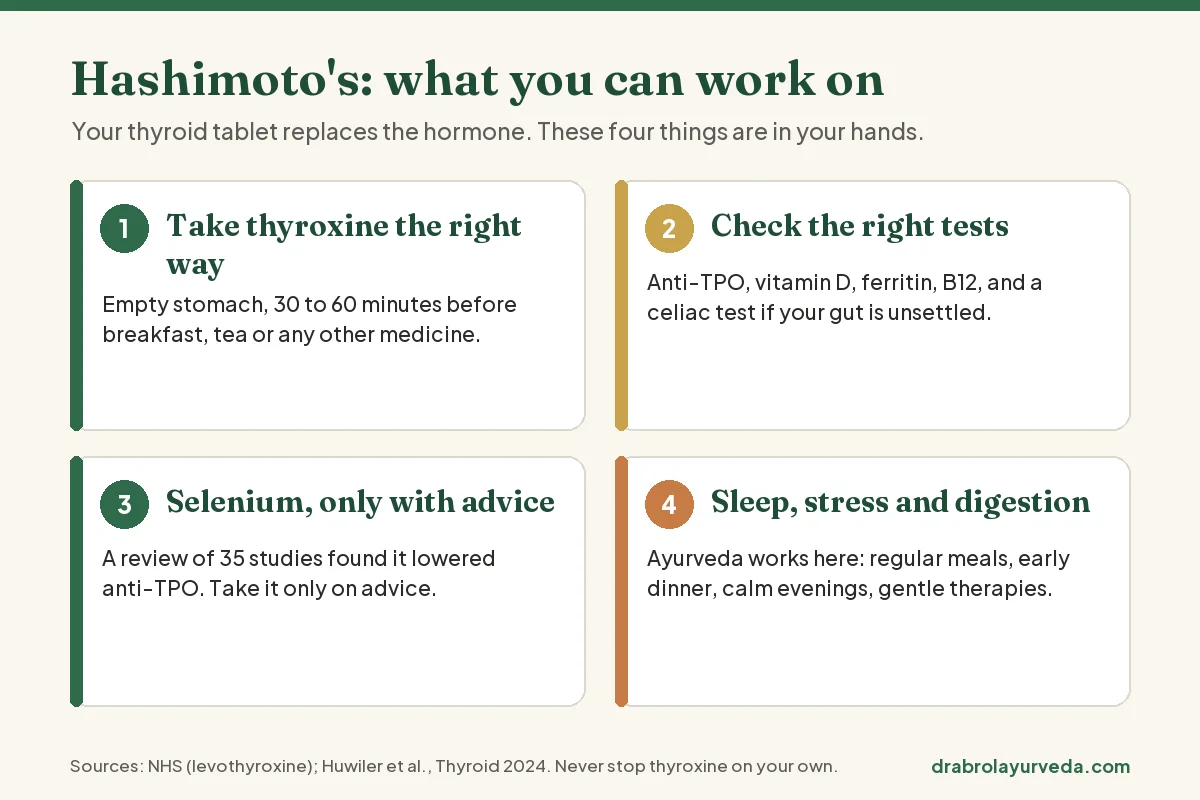
The table shows the common options and what the evidence says.
| Option | What the evidence says | Our view |
|---|---|---|
| Levothyroxine | Replaces missing hormone; usually lifelong (NHS) | Keep taking it, every day |
| Selenium | Lowered anti-TPO across 35 studies | Useful for some, only on advice |
| Gluten-free diet | Only 3 small trials; very uncertain | Test for celiac disease first |
| Vitamin D | Alone, did not clearly lower antibodies | Correct a deficiency anyway |
| Ayurvedic care | Little direct research in Hashimoto's | Helps digestion, sleep and stress |
How to Take Levothyroxine So It Works
Take levothyroxine on an empty stomach with water, 30 to 60 minutes before your first meal, any tea or coffee, or any other medicine (NHS). Taking it the same way every day matters as much as the dose. Small habits can change how much of it your body absorbs.
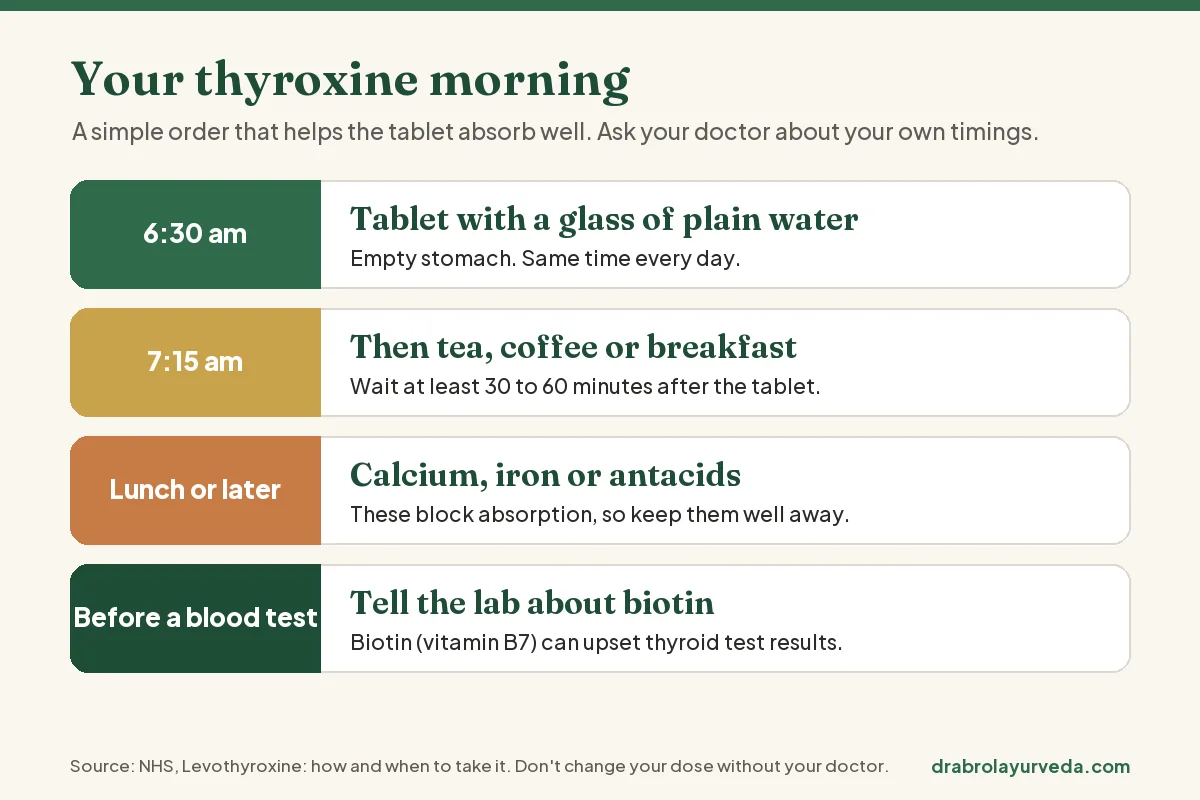
In Punjab, the first cup of chai often comes before anything else. We see many patients who take their tablet with that cup. Moving the chai back by 45 minutes is one of the easiest changes you can make.
Calcium and iron supplements, antacids and some acidity medicines also get in the way (NHS). Take them later in the day. Biotin, often sold for hair and nails, can upset thyroid test results, so tell the lab if you take it.
We usually plan Ayurvedic medicines for later in the day too, well away from the thyroid tablet. Your doctor or pharmacist can tell you the right gap for each one.
Selenium, Gluten and Vitamin D: What the Research Says
Of the three things Hashimoto's patients ask about most, selenium has the best research behind it, a gluten-free diet the weakest, and vitamin D sits in between. None of them replaces your tablet.
Does selenium help Hashimoto's?
Selenium can lower anti-TPO antibodies, but take it only on a doctor's advice. It is a trace mineral, so the right amount matters more than taking a lot.
A 2024 review in the journal Thyroid pooled 35 studies. Selenium lowered anti-TPO antibodies across 29 groups of patients, with 2,358 people in all. In people not yet on thyroid tablets, it also lowered TSH a little. Side effects were about the same as in the comparison groups (Huwiler et al., 2024).
Lower antibodies do not mean the thyroid has healed. The review found no change in thyroid hormone levels or gland size. So selenium is a helper, not a replacement for your tablet. If you take any supplement for hair, skin or immunity, check its label first. Many already contain selenium.
Should you go gluten-free with Hashimoto's?
A gluten-free diet is only clearly needed if you also have celiac disease, so ask for a celiac blood test before cutting out wheat. For people with Hashimoto's who do not have celiac disease, the evidence is weak.
A 2025 review found only three trials, with 110 people in all. The results were mixed and the authors rated the evidence as very uncertain (Araujo et al., 2025). In a Punjabi kitchen, giving up roti is a big change. We do not ask for it without a reason.
We do suggest a celiac test if you have bloating, loose stools, low iron that keeps coming back, or mouth ulcers. A 2026 genetic study found that Hashimoto's raises the risk of celiac disease (Pu et al., 2026). If the test is positive, a strict gluten-free diet becomes part of your treatment.
Vitamin D and the tests to ask for
Besides TSH, the useful tests in Hashimoto's are Free T4, anti-TPO antibodies, vitamin D, ferritin (iron stores) and vitamin B12. Low vitamin D, low iron and low B12 are common, and each can add to tiredness, hair fall and low mood.
Vitamin D is worth correcting if it is low. One review found that vitamin D on its own did not clearly lower anti-TPO antibodies over 6 months (Peng et al., 2024). So we fix a deficiency for your bones, energy and mood, not to bring the antibodies down.
Bring the last two or three sets of reports to your first consultation. We are more interested in the trend over a year than in any single result.
How Ayurveda Approaches Hashimoto's
Ayurveda approaches Hashimoto's by strengthening digestion (Agni), clearing what it calls Ama, meaning poorly digested residue, and calming the stress and sleep problems that often come with it. It works alongside your thyroxine, never instead of it.
In our clinic, most women with Hashimoto's show a mix of two patterns. Some have a Kapha picture: heaviness, weight gain, slow digestion and feeling cold. Others have more Pitta: hair fall, acidity, irritability and poor sleep. The plan differs for each.
Care usually starts with simple things. Warm, cooked meals at regular times. An early, light dinner. Lights out before 11 pm. A daily walk. For stress and poor sleep, we may add oil therapies such as Shirodhara. If acidity and bloating are part of the picture, our guide on acidity, bloating and IBS explains the gut side.
Herbs are chosen only after we read your reports and know your other medicines. We are careful with herbs that can change thyroid levels. Please don't start ashwagandha on your own; our post on whether ashwagandha is safe explains why. Most patients need about three months before we judge any change, with tests repeated by your doctor. Our page on Ayurvedic treatment for thyroid explains the full clinic plan.
A day that suits Hashimoto's
This is the rough shape of the day we plan for most of our Hashimoto's patients. Your own plan will be adjusted for your work, your family and your reports.
- On waking: thyroid tablet with plain water. Then a 20 minute walk or gentle yoga.
- Breakfast, 45 minutes later: something warm, such as poha, daliya or a besan chilla, with your chai.
- Lunch: the main meal of the day, with dal, a cooked sabzi and a little ghee.
- Evening: a light, early dinner by 8 pm, and screens off an hour before bed.
- Night: lights out by 10:30 to 11 pm, with a few minutes of foot oil massage if sleep is poor.
Don't stop or change your prescribed medicines, including thyroxine, without talking to the doctor who prescribed them.
Hashimoto's Myths vs Facts
A few common beliefs about Hashimoto's make people either stop their tablet or try every supplement at once. These are the ones we hear most often.
| Myth | Fact |
|---|---|
| A natural remedy lets you stop the tablet. | A damaged thyroid does not regrow. The tablet replaces what it cannot make. |
| Everyone with Hashimoto's must quit gluten. | It is clearly needed only with celiac disease. Get tested first. |
| More selenium works better. | It is a trace mineral. Take only the dose your doctor advises. |
| Normal TSH means the disease is gone. | It means the dose is right for now. Antibodies can stay raised for years. |
| Ayurveda means stopping your tablets. | Ayurvedic care works alongside your prescribed medicines. |
When to See a Doctor About Hashimoto's
See a doctor soon if your neck swells quickly, if swallowing or breathing becomes hard, or if you plan a pregnancy or become pregnant. In pregnancy, the thyroxine dose often needs checking more often (NHS).
- Feeling sick, diarrhoea, headaches or poor sleep after a dose change, which can mean the dose is wrong (NHS).
- Severe tiredness, feeling very cold, or a very slow pulse.
- Low mood that will not lift, or thoughts of harming yourself.
- A lump in the neck that feels hard or keeps growing.
- New symptoms after any change in your tablet brand or dose.
A Typical Case We See Online
Many of our Hashimoto's patients consult online from abroad, and most of the change comes from small daily habits rather than any one remedy. Here is a composite example, with details changed for privacy.
A 36-year-old teacher from Ludhiana, now living in Brampton, Canada, booked an online consultation. She had Hashimoto's and took 75 mcg of levothyroxine. Her TSH kept moving between tests, her hair was thinning and she felt tired by 3 pm.
Her morning routine was the first clue. She took the tablet with masala chai and an iron capsule. Her ferritin and vitamin D were both low. We moved the tablet to 45 minutes before chai and the iron to lunch. We planned warm breakfasts, an early dinner and an evening walk. Her family doctor corrected the vitamin D and iron.
Over four months her TSH settled, and her dose stayed the same. She had more energy in the afternoons and her hair fall slowed. Her antibodies are still raised, and she still takes her tablet every morning. Results differ from person to person.
Book an Online Thyroid Consultation
If you have Hashimoto's and want a plan that works around your tablet, share your reports and a list of everything you take. Dr. Abrol consults online with patients across India and abroad, and in person in Amritsar.
Book an Online Consultation Visit the Amritsar Clinic
Phone / WhatsApp: +91-9878039127
About the Author
Dr. Amita Abrol is an Ayurvedic physician and Panchakarma specialist in Amritsar, Punjab. She holds a BAMS (Gold Medalist) and an MS in Gynaecology & Obstetrics (Stree Prasuti Tantra). With an MS in Gynaecology and Obstetrics and 14+ years in practice, she sees women with thyroid problems every week, in Amritsar and online. She also sees patients in India and abroad through online consultations.
Experience: 14+ years of supervised Panchakarma practice. Clinic address and phone are listed in the site footer.
References
- Unnikrishnan AG, Kalra S, Sahay RK, et al. Prevalence of hypothyroidism in adults: an epidemiological study in eight cities of India. Indian Journal of Endocrinology and Metabolism, 2013;17(4):647-652.
- NHS. Underactive thyroid (hypothyroidism).
- NHS. Levothyroxine.
- Huwiler VV, Maissen-Abgottspon S, Stanga Z, et al. Selenium supplementation in patients with Hashimoto thyroiditis: a systematic review and meta-analysis of randomized clinical trials. Thyroid, 2024;34(3):295-313.
- Araujo EMQ, Coutinho-Lima CRO, Sousa AS, et al. Effects of gluten-free diet in non-celiac Hashimoto's thyroiditis: a systematic review and meta-analysis. Nutrients, 2025;17(21):3437.
- Peng B, Wang W, Gu Q, et al. Effects of different supplements on Hashimoto's thyroiditis: a systematic review and network meta-analysis. Frontiers in Endocrinology, 2024;15:1445878.
- Pu YH, Long CY, Yue RS, et al. Autoimmune thyroid diseases, celiac disease and gluten-free diet: a Mendelian randomisation study. British Journal of Nutrition, 2026;135(1):31-39.
Images: “Tired woman sitting at a wooden table looking at a laptop” by Shixart1985, CC BY 2.0 (Wikimedia Commons, cropped and resized). The two charts are original diagrams made for this article by Dr. Abrol Ayurveda. The capsules photo is from the Dr. Abrol Ayurveda website image library. Used for education; not photographs of patients at this hospital.
Medical disclaimer: This article is for education and does not replace a consultation with your doctor. Do not stop or change prescribed medicine on your own. Chest pain, fainting, vomiting or loose motions that will not stop, blood in vomit or stools, or a high fever needs urgent care at a hospital.
Have questions about your own symptoms?
Every case is different. Book a consultation with Dr. Abrol for a treatment plan personalised to your Prakriti and health history.
In This Article
- What Is Hashimoto's Thyroiditis?
- Is There a Natural Treatment for Hashimoto's?
- How to Take Levothyroxine So It Works
- Selenium, Gluten and Vitamin D: What the Research Says
- How Ayurveda Approaches Hashimoto's
- Hashimoto's Myths vs Facts
- When to See a Doctor About Hashimoto's
- A Typical Case We See Online
- Book an Online Thyroid Consultation
- About the Author
- References
Book a Consultation
Get a personalised Ayurvedic treatment plan from Dr. Abrol - in clinic or online.
Dr. Amita Abrol
Gold Medalist BAMS, MS Gynaecology
Common Questions
Frequently Asked Questions
No. Hashimoto's is a long-term autoimmune condition, and no diet, herb or supplement has been shown to make it go away. What natural care can do is help you feel better, support steady thyroid tests and sometimes lower antibody levels. Levothyroxine stays the treatment for an underactive thyroid, and any dose change is decided by your doctor from your reports.
Sometimes, yes. In studies, selenium lowered anti-TPO levels in many people with Hashimoto's. Antibodies also rise and fall on their own, so one reading means little. We look at the trend over 6 to 12 months. Lower antibodies are a good sign, but how you feel and your TSH matter more for day-to-day care.
Not on your own. Ashwagandha can change thyroid hormone levels, and it does not suit everyone with autoimmune thyroid disease. If it is right for you, the doctor will choose the dose and recheck your thyroid tests. Our guide on whether ashwagandha is safe explains who should avoid it.
No. Stopping thyroxine lets the symptoms come back: tiredness, weight gain, feeling cold and low mood. Ayurvedic care runs alongside your tablet. If your needs change over time, your doctor will adjust the dose based on blood tests, step by step. Please never stop or skip doses on your own.
Yes. In a study of 5,360 adults across eight Indian cities, hypothyroidism affected 15.86% of women against 5.02% of men, and about 1 in 5 people had raised anti-TPO antibodies. Many women find out during a pregnancy check, after a baby, or when tiredness and weight gain will not settle.
Yes. Hashimoto's suits online care well, because most decisions are made from your symptoms and blood reports. Share your latest TSH, Free T4, anti-TPO, vitamin D, ferritin and B12 results before the call. Dr. Abrol plans diet, routine and any medicines, and your local doctor keeps managing your thyroxine.
Continue Exploring
Related Treatments & Conditions
Keep Reading
More on Women's Health

Ready to Start Your Ayurvedic Healing Journey?
Book a clinic visit or online consultation with Dr. Abrol, based on what you've just read.