
Ayurvedic Lifestyle
Knee Pain in Winter: Why It Gets Worse and What Helps
Many people with stiff knees feel worse from November to February. Dr. Amita Abrol explains what the research says about weather and joint pain, and the simple warm-up, warmth and food habits that help most in a Punjab winter.
- Published November 19, 2026
- 9 minutes read
- Medically reviewed
- By Dr. Amita Abrol

Personally supervised by Dr. Amita Abrol
Gold Medalist BAMS · MS Gynaecology & Obstetrics · 14+ years experience
Key takeaways
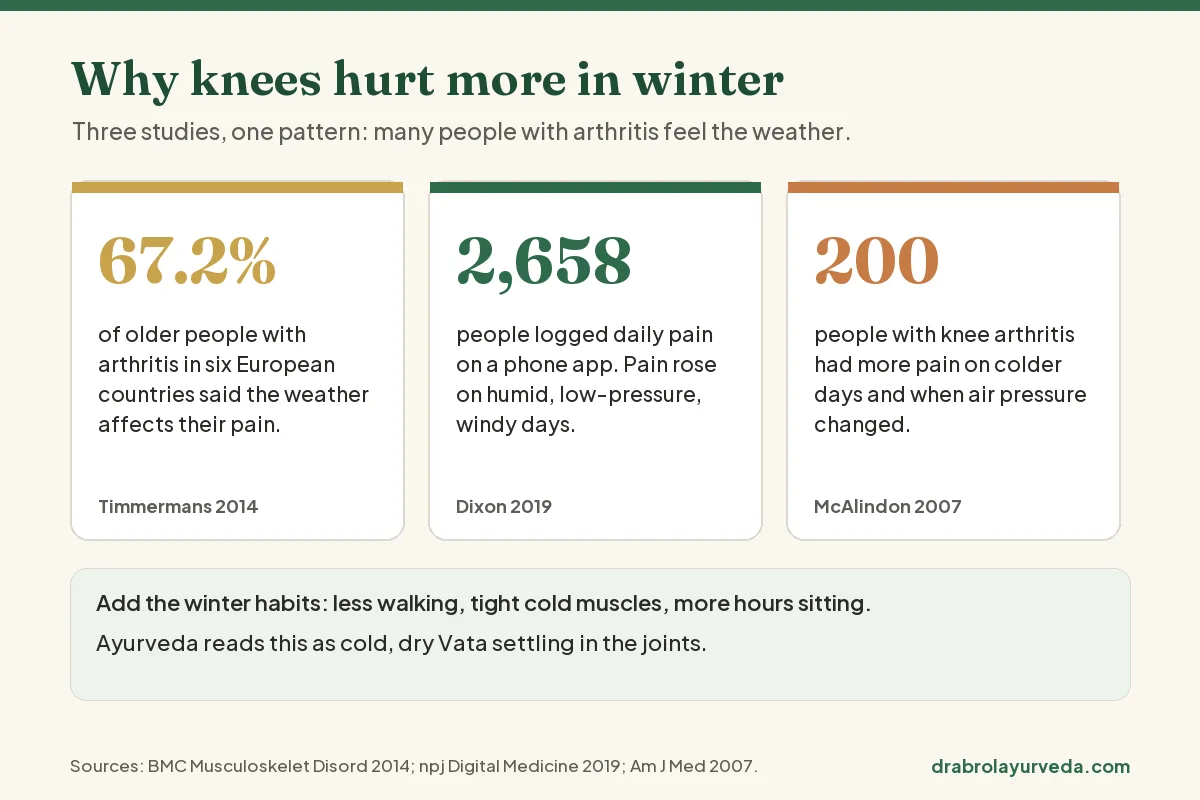
- In one European study, 67.2% of older people with arthritis said they feel the weather in their joints.
- Cold, damp days and swings in air pressure go with more knee pain in several studies.
- Most of us sit more in winter, and idle thigh muscles let the knee stiffen.
- Five minutes of leg moves under the razai makes the first steps of the day easier.
- Dawn fog is the worst time to walk; late morning sun is kinder.
- Oil and heat are for a cold, stiff knee. A hot, red, swollen one needs a doctor.
- Keep taking every prescribed medicine unless your own doctor changes it.
In This Article
- Why Does Knee Pain Increase in Winter?
- Is It Arthritis or Just the Cold?
- A 5-Minute Morning Knee Warm-Up
- How to Keep Your Knees Warm in Winter
- Warm Oil and Potli: Ayurvedic Care for Winter Knees
- What to Eat for Stiff Knees in Winter
- Winter Knee Pain Myths vs Facts
- When Is Winter Knee Pain a Warning Sign?
- A Typical Winter Case We See in Clinic
- Book a Knee Pain Consultation
- About the Author
- References
By Dr. Amita Abrol, BAMS (Gold Medalist), MS · Ayurvedic Physician & Panchakarma Specialist, Amritsar · Medically reviewed · Last updated: 25 November 2026
How this article was prepared: Written by Dr. Amita Abrol from the winter rise in knee pain we see each year among patients in Amritsar. The numbers come from three studies on weather and joint pain, an Indian study of 5,000 adults, a Cochrane review and the Charaka Samhita. Each one is linked below. Author credentials: Dr. Amita Abrol.
Quick answer: Knee pain in winter is common because cold days, damp air and changes in air pressure are linked with more joint pain, and people move less. Ayurveda calls it cold, dry Vata in the joint. A short morning warm-up, warm clothes, warm oil and afternoon walks help most people. A hot, swollen knee needs a doctor.
Why Does Knee Pain Increase in Winter?
Knee pain increases in winter because colder, damper days and shifts in air pressure are linked with more joint pain, and because people move less when it is cold. The effect is real for many people, though it is modest. It is strongest in knees that already have arthritis.
Three studies help explain it. In six European countries, 67.2% of older people with arthritis said the weather affects their pain. Those people also reported more pain (Timmermans et al., 2014). In the UK, 2,658 people logged their pain daily on a phone app for 15 months. Pain was linked with humid, low-pressure and windy days (Dixon et al., 2019). In the US, 200 people with knee arthritis had more pain on colder days and when air pressure changed (McAlindon et al., 2007).
Habits matter as much as the weather. In a Punjab winter, people sit longer under the razai, walk less and climb stairs less. Muscles around the knee get stiff and weak. Many people also eat more heavy food and put on a little weight.
Homes matter too. Most houses in Amritsar have no central heating, and marble floors stay cold from December to February. We see this clearly in families who visit from Canada, the UK or Australia for the wedding season. Their knees were fine in a heated house abroad. After two weeks of cold floors, long sitting at functions and early starts, they arrive at the clinic with stiff, aching knees.
How Ayurveda explains it
Ayurveda says cold and dry qualities raise Vata, the force of movement and dryness. When Vata settles in a joint, the Charaka Samhita describes swelling that feels like an air-filled bag, with pain on bending and straightening (Chikitsa Sthana 28, verse 37). Warmth, oil and steady movement are the classical answer to cold and dry. For the whole-body plan, see our winter routine in Ayurveda.
Is It Arthritis or Just the Cold?
Stiffness that eases within half an hour of moving is usually ordinary winter stiffness or wear and tear, while a hot, swollen knee or stiffness lasting over an hour points to something else. Knee arthritis is common in India. A study of 5,000 adults found it in 28.7% of them (Pal et al., 2016). So many people who notice their knees in winter already have some wear.
The table shows how the common causes differ.
| Pattern | What it feels like | What to do |
|---|---|---|
| Winter stiffness | Stiff on waking, better after a few minutes of moving | Warm-up, warmth, walking |
| Osteoarthritis | Pain on stairs and standing up, cracking, morning stiffness under 30 minutes | Exercise, weight control, a doctor's plan |
| Rheumatoid arthritis | Many swollen joints, often hands, stiffness over an hour | See a doctor soon for blood tests |
| Injury or infection | Sudden pain after a twist or fall, or a hot, red knee with fever | See a doctor the same day |
If several joints swell together, read about rheumatoid arthritis. It needs a different plan from knee wear and tear. If your knees have hurt for years, our guide on knee osteoarthritis after 50 covers the long-term picture.
A 5-Minute Morning Knee Warm-Up
A 5-minute knee warm-up, done in bed before you stand, takes the edge off morning stiffness in winter. Our therapists show it to nearly every knee patient who walks in between November and February. Most of them groan at first. By the second week, many tell us they won't get out of bed without it.
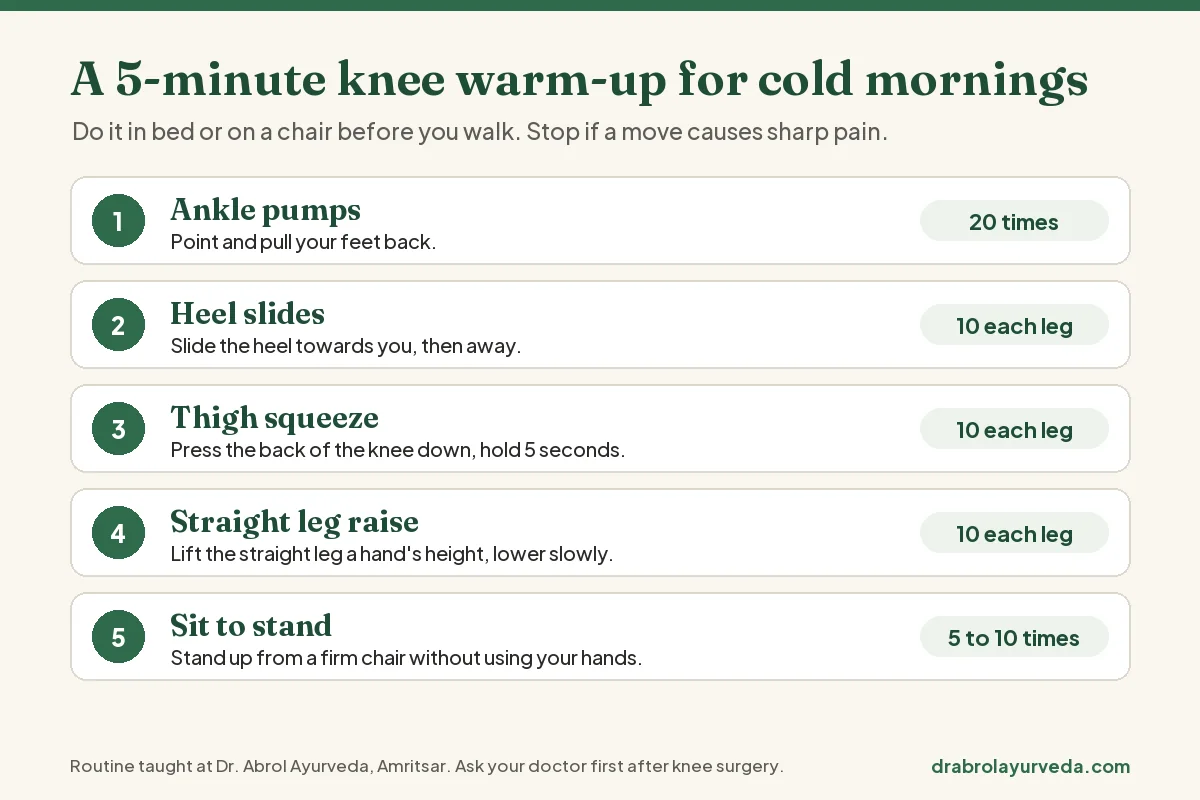
Step 1 to 3: in bed
Lie on your back with the razai still on. Pump both ankles up and down 20 times, like pressing a car pedal. Then bend one knee by sliding the heel towards you and push it back out. Ten times a side is plenty.
The third move matters most. Press the back of your knee flat into the mattress and hold it there while you count to five. You will feel the muscle above the knee cap go hard. That muscle is the knee's shock absorber, and in winter it is usually the first thing to go lazy.
Why before getting up? After a night of lying still in a cool room, the joint fluid and the muscles are at their stiffest. The first few steps to the bathroom are often the most painful of the day. A few minutes of movement under the razai warms things up first.
Step 4 and 5: lift and stand
Still lying down, keep one leg straight and raise it about a hand's height. Lower it slowly, as if the bed were made of glass. Do 10 with each leg. Then sit up, swing your feet down and wait a moment before you stand.
The last move is done on a firm dining chair, not a soft sofa. Fold your arms and stand up, then sit back down slowly. Start with 5 and add one more every few days. Some grandparents count them out loud with a grandchild, which makes it easier to keep going.
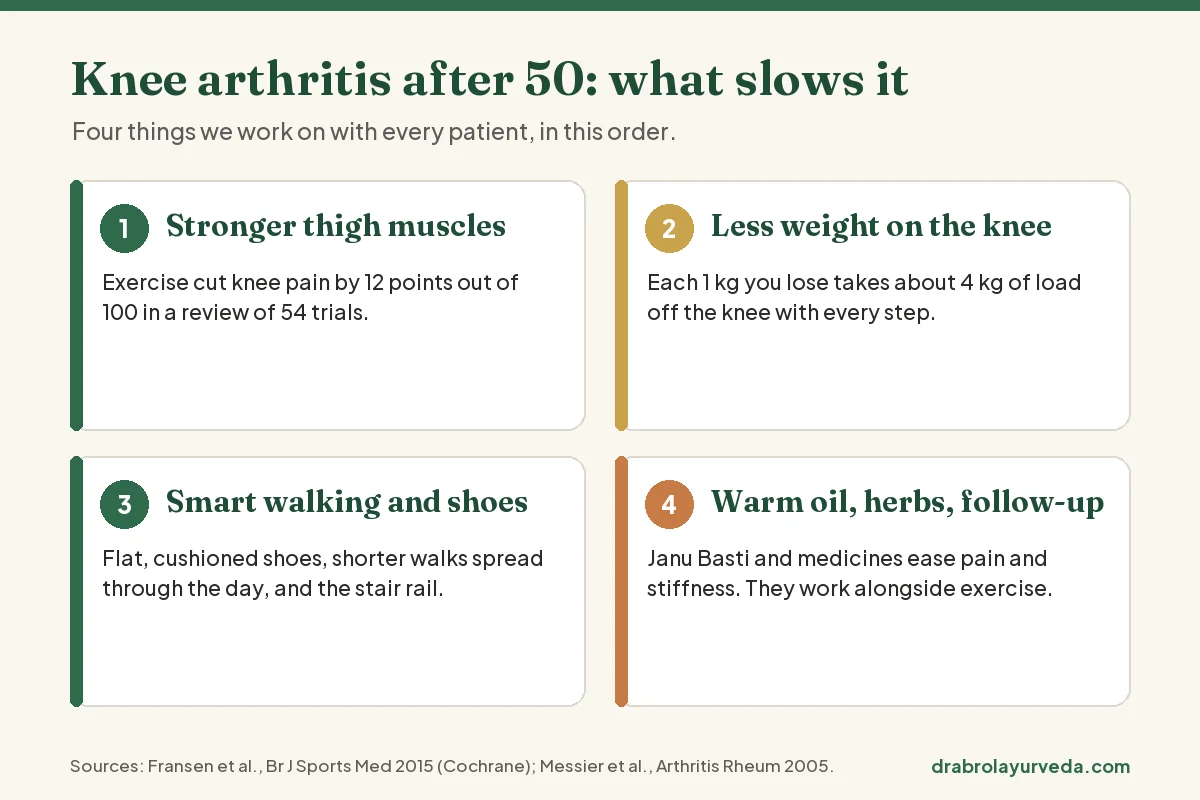
Exercise is one of the best-studied things for knee pain. A Cochrane review of 54 trials found that exercise cut knee pain by 12 points on a 100-point scale (Fransen et al., 2015). The UK's NICE guideline advises it for everyone with osteoarthritis. It warns that the knee may ache a little more in the first weeks, and that this is normal.
How to Keep Your Knees Warm in Winter
To keep knees warm in winter, cover them, keep your feet off cold floors and walk when the sun is up. None of this is new advice. It still surprises us how many patients walk barefoot on marble at 6 am and then wonder why their knees ache by 7.
- Wear warm trousers or thermal leggings. A soft knee cap helps on very cold days.
- Use slippers or socks on marble and stone floors, which stay cold all winter in Punjab homes.
- Walk in the late morning or afternoon sun, not at dawn in fog.
- Bathe with lukewarm water, not very hot water, and dry and cover the knees soon after.
- Sit on a chair rather than on a cold floor. Avoid sitting cross-legged for long.
- At weddings and long functions, stand up and walk around every 30 to 40 minutes.
Visiting family in Punjab this winter? Pack warm socks, a soft knee cap and good walking shoes. Keep up your home exercises during the trip, even if you skip everything else.

Warm Oil and Potli: Ayurvedic Care for Winter Knees
Warm oil massage and a warm herbal potli are the two simplest Ayurvedic ways to ease a stiff winter knee at home. They suit dry, cold, aching knees. They do not suit a knee that is hot, red or swollen.
Oil massage, 5 to 10 minutes
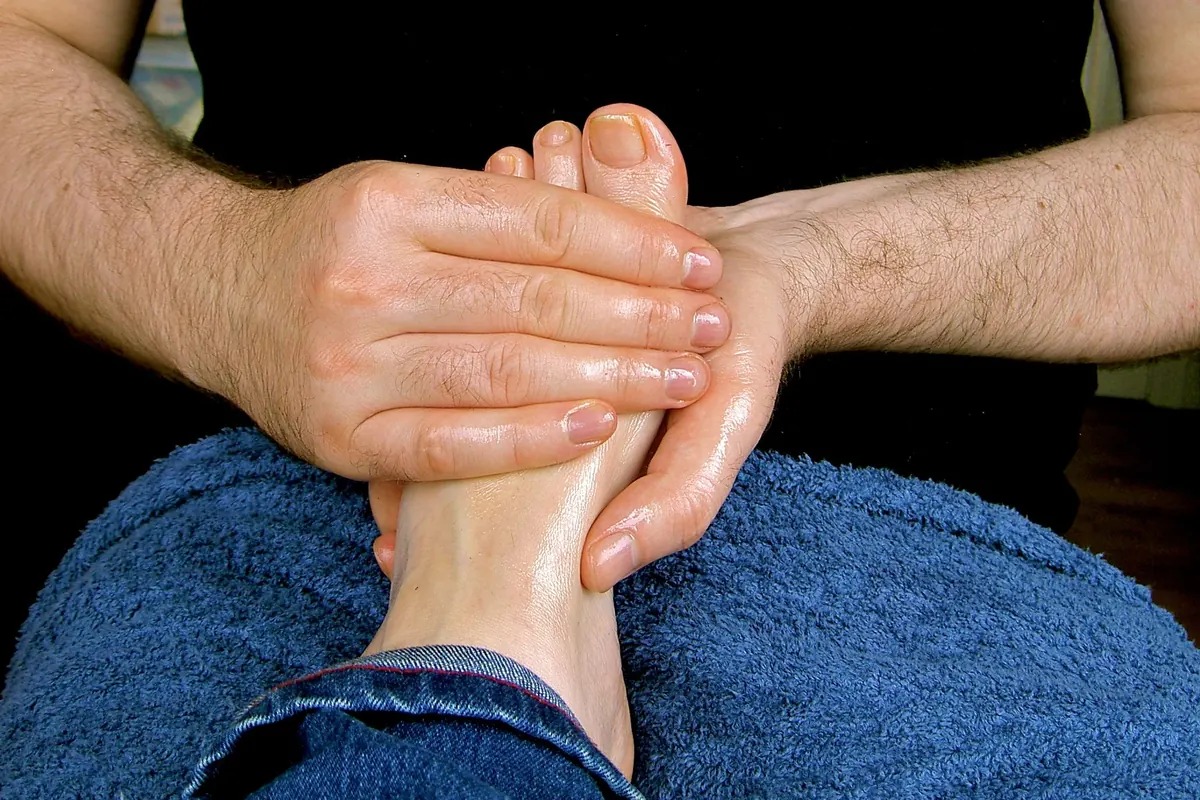
Warm a few spoons of sesame oil, or the oil your doctor has given you. Test it on the inside of your wrist first. Rub it into the knee and the thigh muscle for 5 to 10 minutes, using slow circles around the knee cap. Then bend and straighten the knee a few times and wash off with lukewarm water.
Herbal potli
A potli is a cloth bundle of herbs warmed in a pan of oil, then pressed gently on the knee. It brings warmth and oil together. Our knee care kit includes an oil and a potli with written steps for home use.
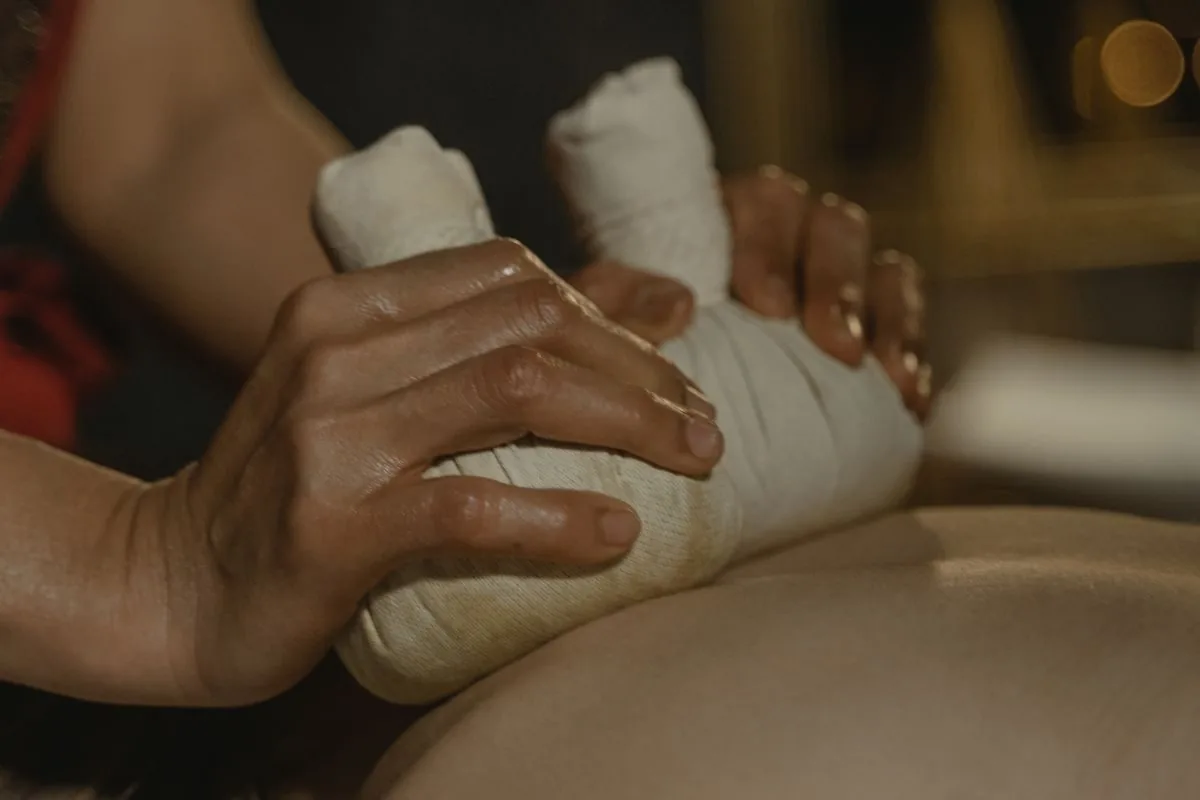
For stubborn winter stiffness, clinic therapies go deeper. Janu Basti holds warm medicated oil over the knee in a dough ring. Patra Pinda Sweda uses a hot bundle of herbal leaves. Both are done by trained therapists at the clinic.
What to Eat for Stiff Knees in Winter
For stiff winter knees, eat warm, freshly cooked meals, add ginger and a little ghee or sesame, and watch the heavy sweets that add weight. Weight matters for knees. Every extra kilo adds load with every step.
- Warm drinks: plain warm water, ginger tea, or turmeric in warm milk at night.
- Cooked vegetables, dal and soups rather than cold salads at night.
- Til (sesame) and a spoon of ghee with meals suit most people.
- Pinni, gajar halwa and fried snacks are part of a Punjab winter. Keep them small, and skip them if you have diabetes or are trying to lose weight.
Don't stop or change your prescribed medicines, including painkillers, BP or diabetes tablets, without talking to the doctor who prescribed them.
Winter Knee Pain Myths vs Facts
A few common beliefs about winter knee pain make people rest too much or wait too long. These are the ones we hear most in clinic.
| Myth | Fact |
|---|---|
| Weather pain is all in the mind. | Studies link colder days and pressure changes with more knee pain. The effect is real, but modest. |
| Rest the knee until summer. | Rest makes muscles weaker and stiffer. Gentle daily movement helps. |
| The hotter the compress, the better. | Too much heat burns skin. Warm, not hot, for 15 to 20 minutes. |
| Oil and heat are good for every sore knee. | A hot, red, swollen knee needs a doctor first. |
| Ayurveda means stopping your tablets. | Ayurvedic care works alongside your prescribed medicines. |
When Is Winter Knee Pain a Warning Sign?
See a doctor the same day if a knee becomes hot, red and swollen, especially with fever, or if you suddenly can't put weight on it. These are not signs of ordinary winter stiffness.
- A swollen, painful calf, especially after a long bus or train ride.
- Many joints swollen at once, with stiffness over an hour each morning.
- A knee that locks, or gives way again and again.
- Pain that wakes you every night, with weight loss you can't explain.
- Pain after a fall on a wet or foggy morning.
A Typical Winter Case We See in Clinic
Every December we see people whose knees were fine in summer and now hurt every morning, and most improve with simple changes. Here is a composite example, with details changed for privacy.
A 62-year-old shopkeeper from Amritsar came in mid-December. His knees had been stiff for three winters, worse each year. He walked to his shop at 6 am in the fog and sat on a cold stool all day. By evening, the stairs at home were hard. He took a painkiller most days from the chemist.
We checked his sugar, his vitamin D and his kidneys before anything else. His vitamin D was low, so his family doctor started treatment. We taught him the 5-minute warm-up and moved his walk to 11 am. He put a cushion and a small heater near his stool. He had 7 sittings of Janu Basti and used warm sesame oil at home each night.
By late January, he walked to his shop without stopping and needed the painkiller only on cold, damp days. He still has some stiffness at dawn. He now starts the warm-up in early November. Results differ from person to person.
Book a Knee Pain Consultation
If winter has made your knees worse, bring your reports and a list of your medicines. Dr. Abrol will examine the knee, rule out warning signs and plan your warm-up, home care and clinic therapies.
Book a Clinic Visit in Amritsar Start with an Online Consultation
For the full clinic plan, see Ayurvedic treatment for knee pain. Phone / WhatsApp: +91-9878039127
About the Author
Dr. Amita Abrol is an Ayurvedic physician and Panchakarma specialist in Amritsar, Punjab. She holds a BAMS (Gold Medalist) and an MS in Gynaecology & Obstetrics (Stree Prasuti Tantra). Each winter she sees a rise in knee, back and neck pain at the clinic, and plans Janu Basti and Panchakarma courses herself. She also sees patients in India and abroad through online consultations.
Experience: 14+ years of supervised Panchakarma practice. Clinic address and phone are listed in the site footer.
References
- Timmermans EJ, van der Pas S, Schaap LA, et al. Self-perceived weather sensitivity and joint pain in older people with osteoarthritis in six European countries: results from EPOSA. BMC Musculoskeletal Disorders, 2014;15:66.
- Dixon WG, Beukenhorst AL, Yimer BB, et al. How the weather affects the pain of citizen scientists using a smartphone app. npj Digital Medicine, 2019;2:105.
- McAlindon T, Formica M, Schmid CH, Fletcher J. Changes in barometric pressure and ambient temperature influence osteoarthritis pain. American Journal of Medicine, 2007;120(5):429-434.
- Pal CP, Singh P, Chaturvedi S, et al. Epidemiology of knee osteoarthritis in India and related factors. Indian Journal of Orthopaedics, 2016;50(5):518-522.
- Fransen M, McConnell S, Harmer AR, et al. Exercise for osteoarthritis of the knee: a Cochrane systematic review. British Journal of Sports Medicine, 2015;49(24):1554-1557.
- National Institute for Health and Care Excellence. Osteoarthritis in over 16s: diagnosis and management (NG226), 2022.
- Charaka Samhita, Chikitsa Sthana, Chapter 28 (Vatavyadhi Chikitsa), verse 37: signs of Sandhigata Vata.
Images: The two charts are original diagrams made for this article by Dr. Abrol Ayurveda. The two photos are from the Dr. Abrol Ayurveda website image library. Used for education; not photographs of patients at this hospital.
Medical disclaimer: This article is for education and does not replace a consultation with your doctor. Do not stop or change prescribed medicine on your own. Chest pain, fainting, vomiting or loose motions that will not stop, blood in vomit or stools, or a high fever needs urgent care at a hospital.
Have questions about your own symptoms?
Every case is different. Book a consultation with Dr. Abrol for a treatment plan personalised to your Prakriti and health history.
In This Article
- Why Does Knee Pain Increase in Winter?
- Is It Arthritis or Just the Cold?
- A 5-Minute Morning Knee Warm-Up
- How to Keep Your Knees Warm in Winter
- Warm Oil and Potli: Ayurvedic Care for Winter Knees
- What to Eat for Stiff Knees in Winter
- Winter Knee Pain Myths vs Facts
- When Is Winter Knee Pain a Warning Sign?
- A Typical Winter Case We See in Clinic
- Book a Knee Pain Consultation
- About the Author
- References
Book a Consultation
Get a personalised Ayurvedic treatment plan from Dr. Abrol - in clinic or online.
Dr. Amita Abrol
Gold Medalist BAMS, MS Gynaecology
Common Questions
Frequently Asked Questions
Yes, gentle heat helps most stiff, aching knees. Wrap the bottle in a towel and keep it on for 15 to 20 minutes. Never sleep with it on the skin, and take extra care if you have diabetes or numb feet, because burns are common. Don't use heat on a knee that is hot, red and swollen.
You don't have to stop walking, but change the time. Early mornings in a Punjab winter are the coldest and often foggy, and the ground can be damp. Walk in the late morning or afternoon sun instead. Do the 5-minute warm-up first, wear warm socks and good shoes, and keep the knees covered.
Low vitamin D is common in India, especially in older people who stay indoors in winter. A blood test will show your level. If it is low, your doctor will prescribe the right dose. Don't take high-dose vitamin D on your own for months, because too much of it can harm the kidneys.
Knees often ache more at night because you have been still for hours and the room cools down. Keep the knee covered, use a pillow between the knees if you sleep on your side, and do a few ankle pumps if you wake up stiff. Pain that wakes you every night, with swelling or weight loss, needs a check-up.
A soft knee cap keeps the joint warm, and many of our patients find it comfortable on cold days. It does not replace exercise, because the thigh muscles are the real support. Take it off at night, and don't wear a tight one for long hours if your legs swell.
Yes, daily warm oil massage suits most stiff knees in winter. Use a few spoons of warm sesame oil or the oil your doctor gives you, rub it in for 5 to 10 minutes, then wash with lukewarm water. Skip the oil on broken skin, a rash, or a hot, swollen joint.
Continue Exploring
Related Treatments & Conditions
Keep Reading
More on Ayurvedic Lifestyle
Ayurvedic Lifestyle
Read Article
Knee Osteoarthritis After 50: What Actually Helps, and What Doesn't
Ready to Start Your Ayurvedic Healing Journey?
Book a clinic visit or online consultation with Dr. Abrol, based on what you've just read.