Ayurvedic Lifestyle
Knee Osteoarthritis After 50: What Actually Helps, and What Doesn't
Worn knees are common after 50, and most people can still walk, climb stairs and stay independent. Dr. Amita Abrol explains what the research and our clinic show actually helps, what doesn't, and when a knee replacement is the better choice.
- Published November 5, 2026
- 10 minutes read
- Medically reviewed
- By Dr. Amita Abrol

Personally supervised by Dr. Amita Abrol
Gold Medalist BAMS · MS Gynaecology & Obstetrics · 14+ years experience
Key takeaways
- About 29% of adults in a large Indian study had knee osteoarthritis.
- Worn cartilage does not grow back, but pain and walking can improve.
- Exercise cut knee pain by 12 points out of 100 in a Cochrane review.
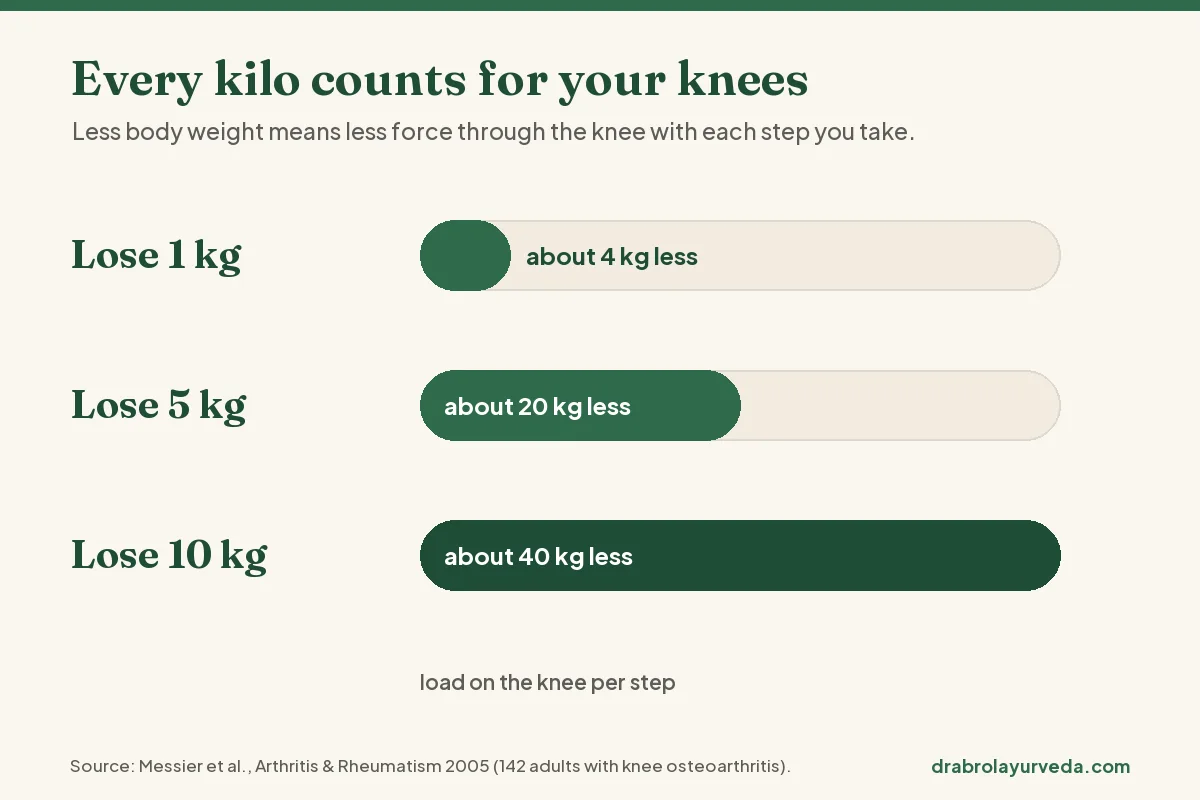
- Each 1 kg of weight lost takes about 4 kg of load off the knee per step.
- Janu Basti and herbs work best alongside exercise, judged over about 3 months.
- A knee replacement is worth discussing when pain still limits daily life.
- Never stop prescribed medicines, such as BP or diabetes tablets, on your own.
In This Article
- What Is Knee Osteoarthritis?
- Why Does Knee Arthritis Get Worse After 50?
- What Actually Helps Knee Osteoarthritis?
- How Ayurveda Treats Knee Osteoarthritis
- Do You Need an X-ray for Knee Pain After 50?
- When Is a Knee Replacement the Better Choice?
- Knee Arthritis Myths vs Facts
- When to See a Doctor About Knee Pain
- A Typical Case We See in Clinic
- Book a Knee Pain Consultation
- About the Author
- References
By Dr. Amita Abrol, BAMS (Gold Medalist), MS · Ayurvedic Physician & Panchakarma Specialist, Amritsar · Medically reviewed · Last updated: 25 November 2026
How this article was prepared: Written by Dr. Amita Abrol from what we see in older patients with knee pain at our Amritsar clinic. The numbers come from an Indian study of 5,000 adults, a Cochrane review, two trials on weight and the knee, the NICE guideline and the Charaka Samhita. Each one is linked below. Author credentials: Dr. Amita Abrol.
Quick answer: Knee osteoarthritis after 50 is common, and worn cartilage does not grow back. Pain and walking can still improve. Stronger thigh muscles, less body weight, good shoes and pacing help most. Warm oil therapies such as Janu Basti and herbs work alongside exercise. Surgery is for pain that still limits daily life.
What Is Knee Osteoarthritis?
Knee osteoarthritis is wear of the smooth cartilage that covers the ends of the knee bones, so the joint becomes stiff, painful and sometimes swollen. It is the most common reason for knee pain after 50. Doctors often shorten it to OA.
Cartilage works like a cushion. As it thins, the bones sit closer together. Small bony lumps called bone spurs can grow at the edges. This is what people in Punjab often mean when they say the doctor found a "knee gap" on the X-ray. The gap between the bones has become narrower.
Ayurveda calls this Janu Sandhigata Vata, which means Vata (the force of movement and dryness) settling in the knee joint. The Charaka Samhita describes it as a swelling that feels like a bag filled with air, with pain on bending and straightening the joint (Chikitsa Sthana 28, verse 37). Patients describe the same thing today. "My knee feels puffy, it cracks, and it hurts when I get up."
Why Does Knee Arthritis Get Worse After 50?
Knee arthritis gets worse after 50 because cartilage wears with age, thigh muscles weaken, weight often rises and many people sit more. In women, the years around menopause add to this. Age is the one factor you can't change. Most of the others you can.
A study of 5,000 adults at five sites across India found knee osteoarthritis in 28.7% of them (Pal et al., 2016). It was more common in women, at 31.6%. Being overweight, getting older and doing sitting jobs were all linked with it.
In our clinic, the pattern is familiar. A woman in her fifties gains a few kilos after menopause. She walks less because her knee hurts. Her thigh muscles get weaker, so the knee takes more of the strain. Then the pain gets worse, and she walks even less. Breaking this loop is the first goal of treatment.
What Actually Helps Knee Osteoarthritis?
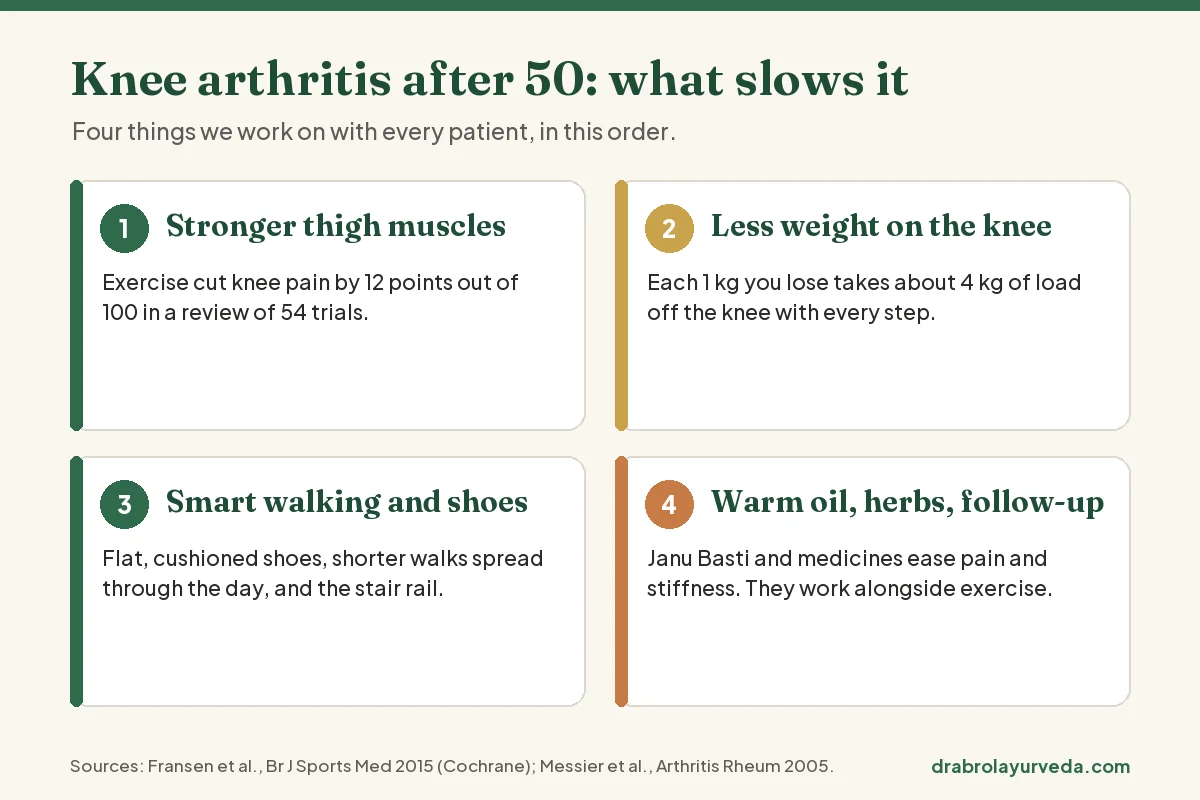
The things that help knee osteoarthritis most are exercise that builds the thigh muscles, losing extra weight, and walking in a way the knee can handle. Ayurvedic therapies and medicines help many people with pain and stiffness, and they work best on top of these basics.
The table compares the main options and what the evidence says about each.
| Option | What the evidence says | How we use it |
|---|---|---|
| Thigh and hip exercise | Less pain and better function in a review of 54 trials | Daily, started in clinic, then at home |
| Weight loss | Less load on the knee with every kilo lost | Diet plan with a target of 5 to 10% of body weight |
| Janu Basti, oil and heat | Small Indian studies show relief; larger trials are still needed | A course of about 7 sittings, then home care |
| Ayurvedic medicines | One large trial matched two common modern options | Chosen after reports, with liver tests checked |
| Knee replacement | Advised when other care has not worked | We refer you to an orthopaedic surgeon |
Strengthen your thigh muscles
The big muscle at the front of the thigh, the quadriceps, acts as the knee's shock absorber. When it is weak, the joint takes the hit. A Cochrane review of 54 trials found that exercise cut knee pain by 12 points on a 100-point scale straight after treatment (Fransen et al., 2015). The benefit was still there 2 to 6 months later.
The NICE guideline from the UK advises exercise for everyone with osteoarthritis. It also warns that the knee may ache a little more in the first weeks. That ache is normal and should not stop you. We start with simple moves: thigh squeezes, straight leg raises and standing up from a chair without using your hands.
Take weight off the knee
Every kilo matters more than people think. In a study of 142 older adults with knee arthritis, each 1 kg of weight lost took about 4 kg of force off the knee with every step (Messier et al., 2005). Over thousands of steps a day, that adds up.
A later trial called IDEA followed 454 overweight adults aged 55 and over for 18 months. The group that combined diet with exercise lost 11.4% of their body weight on average. They had less pain and moved better than people who did diet alone or exercise alone (Messier et al., 2013).
Walk smart: shoes, stairs and pacing
Wear flat, cushioned shoes with a firm back. Avoid thin chappals for long walks. Split your walking into two or three short walks rather than one long one. On stairs, hold the rail. Go up with the stronger leg first and come down with the sorer leg first.
How Ayurveda Treats Knee Osteoarthritis
Ayurveda treats knee osteoarthritis by calming Vata in the joint with warm oil therapies, diet, herbs and gentle movement, alongside the exercise and weight plan. We look at your digestion, sleep, weight and other illnesses before choosing anything.
The main local therapy is Janu Basti. A ring of black gram dough is sealed around the knee and filled with warm medicated oil. One sitting takes about 45 minutes, and a course is usually 7 sittings. We often pair it with Patra Pinda Sweda, a warm bundle of herbal leaves pressed on the joint, or with a full-body Abhyangam oil massage.
Herbal medicines are chosen only after we read your reports and know your other tablets. One large Indian trial is worth knowing. In 440 people with knee arthritis, two standard Ayurvedic formulas eased pain and improved function as well as glucosamine or celecoxib, a common painkiller, over 24 weeks (Chopra et al., 2013). Some patients in the trial had a rise in a liver enzyme, so we check liver tests during treatment.
Honest limits matter here. A 2016 review of Ayurvedic knee studies found most were small and tested only one or two parts of treatment (Sharma et al., 2016). We judge your progress by what you can do, such as stairs and walking time, over about three months. Our page on Ayurvedic treatment for knee pain explains the full clinic plan.
Don't stop or change your prescribed medicines, including tablets for blood pressure, diabetes, thyroid or the heart, without talking to the doctor who prescribed them.
Do You Need an X-ray for Knee Pain After 50?
Most people over 45 with typical knee pain do not need an X-ray to be diagnosed with knee osteoarthritis. The NICE guideline says doctors can diagnose it from your story and an examination. The typical story is pain with activity and morning stiffness that lasts 30 minutes or less.
An X-ray helps when something does not fit. That includes a hot, swollen joint, pain after a fall, or a knee that locks. It is also needed before any surgery is planned.
Many patients bring us an X-ray report that worries them. "Severe knee gap" sounds frightening. But the picture and the pain often don't match. Some people with a narrow gap walk well, and some with a mild X-ray have a lot of pain. We treat the person, not the report.
When Is a Knee Replacement the Better Choice?
A knee replacement is worth discussing when knee pain or stiffness still badly limits your daily life after exercise, weight loss and pain relief have been tried properly. That is the NICE guideline's advice. Age, gender and weight alone should not rule anyone out.
In our clinic, we suggest a surgical opinion when one of these is true:
- Pain wakes you most nights, even after a full course of treatment.
- You can't walk to the gurdwara, the market or the bus stop.
- The knee is getting more bent or bowed over months.
- You have been housebound because of the knee.
Ayurveda can still help before and after surgery. Many of our patients use exercise and oil care to keep the other knee strong. We work with your orthopaedic surgeon, not against them.
Knee Arthritis Myths vs Facts
Most of the fear around knee arthritis comes from a few common beliefs that are not true. These are the ones we hear most often from patients and their families.
| Myth | Fact |
|---|---|
| Rest is the best thing for a worn knee. | Too much rest weakens the thigh muscles, and the knee gets worse. Regular, gentle activity helps. |
| A "knee gap" on X-ray means surgery. | Many people with a narrow gap manage well without surgery. Pain and function decide, not the report. |
| Oil massage alone will fix it. | Oil and heat ease stiffness. Exercise and weight loss do the heavy lifting. |
| Arthritis is just old age, nothing helps. | Most people can walk better and hurt less with the right plan. |
| Ayurveda means stopping your tablets. | Ayurvedic care works alongside your prescribed medicines. |
When to See a Doctor About Knee Pain
See a doctor soon if your knee is hot, red and swollen, if you can't put weight on it, or if the pain came on suddenly after a fall or a twist. These are not the usual signs of wear and tear.
- Fever with a hot, swollen joint. This can be an infection and needs a hospital the same day.
- A swollen, painful calf, especially after a long bus ride, a flight or surgery.
- A knee that locks or gives way again and again.
- Pain at night with weight loss you can't explain.
- Swelling in many joints, such as the fingers and wrists, with morning stiffness over an hour. This may be rheumatoid arthritis, which needs a different plan.
Pain that runs down the back of the leg from the buttock is often from the back, not the knee. Our guide on how to know if leg pain is sciatica explains the difference.
A Typical Case We See in Clinic
Most people who come to us with knee osteoarthritis after 50 have been told to "live with it" or to have surgery, and the truth is usually in between. Here is a composite example, with details changed for privacy.
A 58-year-old retired school teacher from Amritsar came with pain in both knees for three years. The right knee was worse. She weighed 78 kg. She had stopped going up to the roof and found the gurdwara steps hard. An X-ray report said "reduced joint space", and a relative had told her she needed new knees.
She took tablets for blood pressure, which she kept taking. Her liver and kidney tests were normal. We started a course of 7 Janu Basti sittings and taught her four simple exercises. Her diet plan cut evening snacks and fried food. Herbs were added after we read her reports.
After three months, she had lost 5 kg. She climbed the gurdwara steps with the rail and walked 20 minutes twice a day. Her knees still ache after a long day, and she knows a surgical opinion may be needed one day. For now, she uses the knee care kit at home between visits. Results differ from person to person.
Book a Knee Pain Consultation
If your knees have started to limit your day, bring your reports, your list of medicines and any X-ray. Dr. Abrol will examine the knee, explain what is going on and plan your exercise, diet and therapy together.
Book a Clinic Visit in Amritsar Start with an Online Consultation
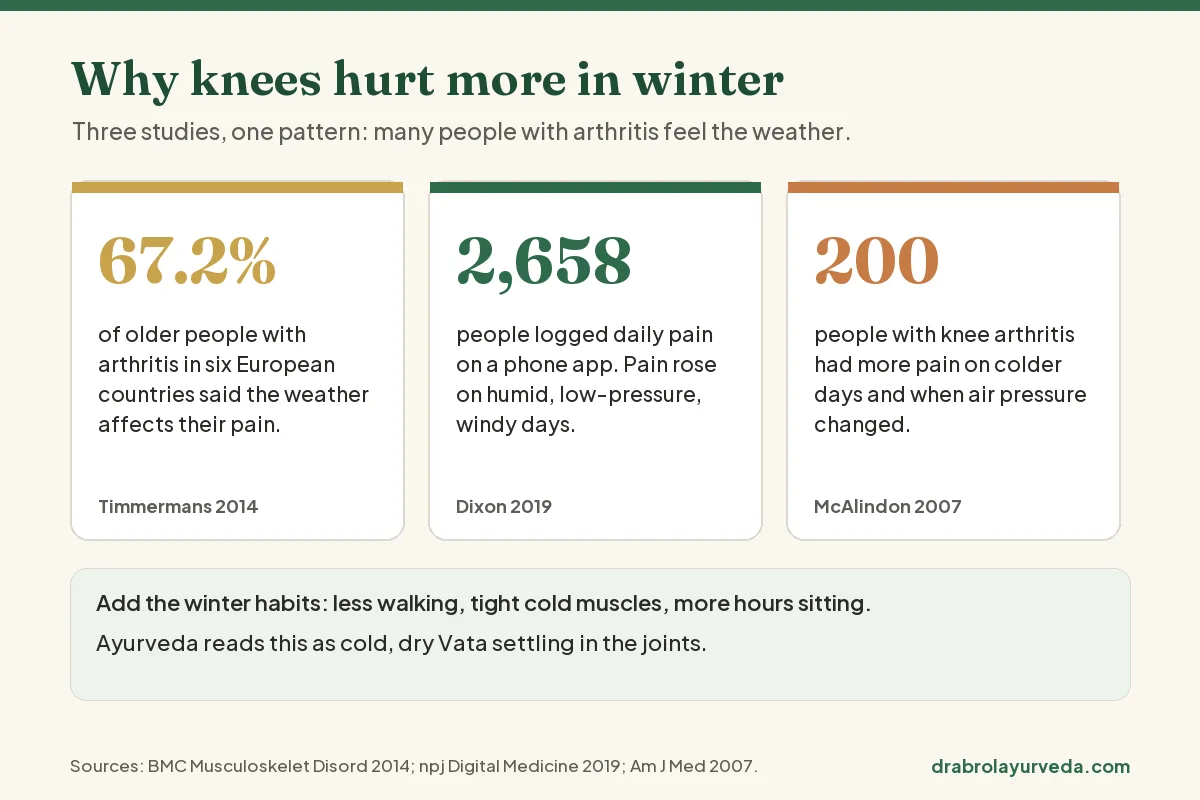
Living abroad, or booking for a parent? Many families start online. Read our winter guide too: why knee pain gets worse in winter. Phone / WhatsApp: +91-9878039127
About the Author
Dr. Amita Abrol is an Ayurvedic physician and Panchakarma specialist in Amritsar, Punjab. She holds a BAMS (Gold Medalist) and an MS in Gynaecology & Obstetrics (Stree Prasuti Tantra). She sees older patients with knee, back and neck pain every week, and plans Janu Basti, Kati Basti and Panchakarma courses herself. She also sees patients in India and abroad through online consultations.
Experience: 14+ years of supervised Panchakarma practice. Clinic address and phone are listed in the site footer.
References
- Pal CP, Singh P, Chaturvedi S, et al. Epidemiology of knee osteoarthritis in India and related factors. Indian Journal of Orthopaedics, 2016;50(5):518-522.
- Fransen M, McConnell S, Harmer AR, et al. Exercise for osteoarthritis of the knee: a Cochrane systematic review. British Journal of Sports Medicine, 2015;49(24):1554-1557.
- Messier SP, Gutekunst DJ, Davis C, DeVita P. Weight loss reduces knee-joint loads in overweight and obese older adults with knee osteoarthritis. Arthritis & Rheumatism, 2005;52(7):2026-2032.
- Messier SP, Mihalko SL, Legault C, et al. Effects of intensive diet and exercise on knee joint loads, inflammation, and clinical outcomes: the IDEA randomized clinical trial. JAMA, 2013;310(12):1263-1273.
- Chopra A, Saluja M, Tillu G, et al. Ayurvedic medicine offers a good alternative to glucosamine and celecoxib in the treatment of symptomatic knee osteoarthritis. Rheumatology, 2013;52(8):1408-1417.
- Sharma A, Shalini TV, Sriranjini SJ, Venkatesh BA. Management strategies for Janu Sandhigata Vata vis-a-vis osteoarthritis of knee: a narrative review. AYU, 2016;37(1):11-17.
- National Institute for Health and Care Excellence. Osteoarthritis in over 16s: diagnosis and management (NG226), 2022.
- Charaka Samhita, Chikitsa Sthana, Chapter 28 (Vatavyadhi Chikitsa), verse 37: signs of Sandhigata Vata.
Images: The two charts are original diagrams made for this article by Dr. Abrol Ayurveda. The two photos are from the Dr. Abrol Ayurveda website image library. Used for education; not photographs of patients at this hospital.
Medical disclaimer: This article is for education and does not replace a consultation with your doctor. Do not stop or change prescribed medicine on your own. Chest pain, fainting, vomiting or loose motions that will not stop, blood in vomit or stools, or a high fever needs urgent care at a hospital.
Have questions about your own symptoms?
Every case is different. Book a consultation with Dr. Abrol for a treatment plan personalised to your Prakriti and health history.
In This Article
- What Is Knee Osteoarthritis?
- Why Does Knee Arthritis Get Worse After 50?
- What Actually Helps Knee Osteoarthritis?
- How Ayurveda Treats Knee Osteoarthritis
- Do You Need an X-ray for Knee Pain After 50?
- When Is a Knee Replacement the Better Choice?
- Knee Arthritis Myths vs Facts
- When to See a Doctor About Knee Pain
- A Typical Case We See in Clinic
- Book a Knee Pain Consultation
- About the Author
- References
Book a Consultation
Get a personalised Ayurvedic treatment plan from Dr. Abrol - in clinic or online.
Dr. Amita Abrol
Gold Medalist BAMS, MS Gynaecology
Common Questions
Frequently Asked Questions
No treatment, Ayurvedic or modern, has been shown to grow worn knee cartilage back. What can change is how the knee feels and works. Stronger thigh muscles, less body weight, warm oil therapies and the right medicines often mean less pain and easier walking. We judge progress by what you can do, such as stairs and walking time, not by the X-ray.
Yes, walking is good for most people with knee osteoarthritis. Keep it short and regular rather than long and rare. Two or three walks of 10 to 15 minutes on flat ground suit most of our patients better than one hour at a stretch. A little ache that settles within a day is fine. Pain that lasts longer means you did too much.
Most people do not need to stop. Use the rail, take one step at a time, and lead with the stronger leg going up and the sorer leg going down. If you live upstairs, plan your trips so you climb fewer times a day. Stronger thigh muscles make stairs easier within a few weeks for many people.
Deep squatting and sitting cross-legged put heavy load on worn knees, so we usually advise a low stool, a chair or a western toilet seat, at least while the knee is sore. Many of our patients in Amritsar sit on a low stool for prayers or in the kitchen. Small changes like this often ease the daily ache.
A course at our clinic is usually 7 sittings of about 45 minutes each, often on back-to-back days. Some people need a second course after a few months. Janu Basti works best alongside daily exercise and, where needed, medicines. The doctor decides the plan after examining your knee.
Turmeric in food is safe for most people and is part of a healthy kitchen. High-dose turmeric capsules are a different matter. They can interact with blood thinners and are not right for everyone. Ask the doctor before you start any supplement, especially if you take medicines for blood pressure, diabetes or the heart.
Continue Exploring
Related Treatments & Conditions
Keep Reading
More on Ayurvedic Lifestyle

Ready to Start Your Ayurvedic Healing Journey?
Book a clinic visit or online consultation with Dr. Abrol, based on what you've just read.