Ayurvedic Lifestyle
AYUSH Visa for Ayurveda Treatment in India: Who Needs It and How It Works
The AYUSH visa is for foreign nationals who come to India mainly for Ayurveda, Yoga or other Indian systems of medicine. Dr. Amita Abrol explains who needs it, who does not, the documents and hospital letter, and how family can come with you.
- Published November 26, 2026
- 10 minutes read
- By Dr. Amita Abrol
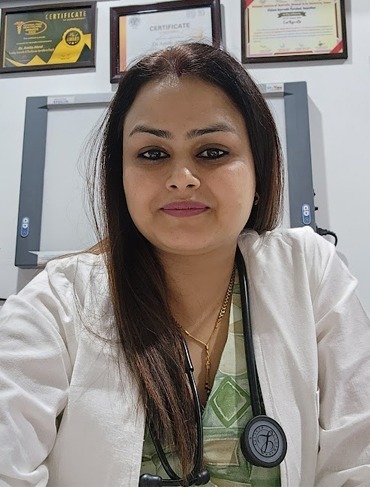
Personally supervised by Dr. Amita Abrol
Gold Medalist BAMS · MS Gynaecology & Obstetrics · 14+ years experience
Key takeaways
- The AYUSH visa is for foreigners coming mainly for treatment under Indian systems of medicine.
- Indian passport holders and OCI cardholders do not need an AYUSH visa.
- Online, it appears as e-Medical Visa for e-Ayush purpose; apply 4 to 120 days ahead.
- You need a letter from the hospital on its letterhead, with your passport details.
- Up to two attendants or family members can get the attendant visa.
- e-Visas cannot be extended or converted, so plan the full course before you apply.
- Rules change; check the official page for your category on the day you apply.
In This Article
- What Is the AYUSH Visa?
- Who Needs an AYUSH Visa, and Who Doesn't?
- e-AYUSH Visa or Regular AYUSH Visa: Which Route?
- Documents and the Hospital Letter
- Can Family Come With You? The Attendant Visa
- When to Apply: A Simple Timeline
- AYUSH Visa: Myths vs Facts
- Health Checks Before You Travel for Treatment
- A Typical Visa Question We Get
- Plan Your Ayurveda Treatment in India
- About the Author
- References
By Dr. Amita Abrol, BAMS (Gold Medalist), MS · Ayurvedic Physician & Panchakarma Specialist, Amritsar · Last updated: 27 November 2026
How this article was prepared: Written by Dr. Amita Abrol from the visa questions overseas patients ask before an online consultation. Every rule below is quoted from the Government of India e-Visa page or an Indian embassy or consulate page, read on 27 November 2026. Visa rules change, so always check the official page on the day you apply. Author credentials: Dr. Amita Abrol.
Quick answer: The AYUSH visa is an Indian visa for foreign nationals whose main reason for coming is treatment under Ayurveda, Yoga or another Indian system of medicine. You can apply online, where it is listed as an e-Medical visa for e-Ayush purpose, or through an Indian mission. Indian passport and OCI holders do not need it.

What Is the AYUSH Visa?
The AYUSH visa is a category of Indian visa for foreign nationals who come to India mainly for treatment under Indian systems of medicine. AYUSH stands for Ayurveda, Yoga and Naturopathy, Unani, Siddha, Sowa-Rigpa and Homoeopathy.
The Embassy of India in The Hague says the AY-1 visa is for a foreigner “whose sole purpose is to seek treatment through Ayush systems / Indian systems of medicine”. The Consulate in Edinburgh called it “a new category” in its June 2024 notice.
For years, overseas patients asked us whether a tourist or a medical visa suited a three-week Panchakarma course. The AYUSH visa answers that question. Treatment under Indian systems of medicine now has its own route.
If you are new to the therapy itself, our page on what Panchakarma involves explains the steps.
Who Needs an AYUSH Visa, and Who Doesn't?
You need an AYUSH visa only if you hold a foreign passport, have no OCI card, and are coming mainly for treatment. Many people of Indian origin do not need one at all.
The table shows the common cases we see among overseas patients.
| Your situation | AYUSH visa needed? | What to check |
|---|---|---|
| Indian passport (NRI) | No | Passport validity only |
| Foreign passport with OCI card | No | OCI record shows your current passport |
| Foreign passport, no OCI, coming for treatment | Yes | e-Visa or regular AYUSH visa |
| Family member coming with a patient | Attendant visa | Up to two people per patient |
If you are an NRI or OCI holder, our guide to Panchakarma in India for NRIs covers the rest of your planning.
Not sure which row is you?
Look at the cover of your passport first. If it says Republic of India, you need no visa. If it is a foreign passport, look for an OCI card or an OCI sticker. If you have one, you need no visa either.
If you have neither, you need a visa. Pick the AYUSH category if treatment is the main reason for the trip. If you plan to see friends and sightsee as well, that is fine. Just be clear on the form about why you are coming.
Children follow the same rules as adults. Each child needs their own passport and their own visa or OCI card.
e-AYUSH Visa or Regular AYUSH Visa: Which Route?
Most patients use the e-Visa route, which is done online and is quicker. The regular AYUSH visa goes through an Indian embassy or consulate. Both routes are open, as the High Commission in Port of Spain explains.
The e-Visa route
On the official e-Visa form, the AYUSH option appears as “e-Medical Visa (For e-Ayush purpose)”. The page numbers more than 170 eligible countries and territories. These are the rules that matter most for treatment:
- Apply at least 4 days before you travel, and no more than 120 days ahead.
- Your passport needs at least six months of validity and two blank pages.
- The page states that “e-Visa is non-extendable and non-convertible”.
The e-Visa page gives two different validity figures for this category in different sections. Check the one shown for your category on the day you apply, and plan your course to fit inside it.
The regular route
You apply on the same website under the regular or paper visa option, then submit it at the Indian mission or its visa centre. Some missions ask you to attend in person for biometrics. Fees differ by country. In June 2024, the Consulate in Edinburgh quoted GBP 101, the same as a medical visa.
Documents and the Hospital Letter
The key document for an AYUSH visa is a letter from the hospital or wellness centre in India, on its letterhead, confirming your treatment. Ask for it early, because everything else depends on it.
The e-Visa page asks for a “Copy of Letter from the Hospital concerned in India on its letterhead”. It should show your name, nationality and passport number, and the date your treatment begins.
Indian missions also describe which centres qualify. The Embassy in The Hague says the centre “should be accredited and registered with any Government authority(ies) concerned or NABH/ NCH/ NCISM accredited hospitals providing Ayush services”. Ask your centre for its registration details along with the letter.
A good centre should be open about who its doctors are. Our guide on how to choose an Ayurvedic doctor lists what to check.
The usual document list
- Passport with six months of validity and two blank pages.
- A recent photograph, to the size the form asks for.
- The hospital or wellness centre letter on its letterhead.
- A prescription or medical history. Missions note this is “not applicable to wellness”.
- Proof of funds, such as a return ticket and enough money. The Embassy in Mexico asks for 3 months of bank statements.
Can Family Come With You? The Attendant Visa
Yes. Up to two family members or attendants can come with an AYUSH visa patient, on the AY-2 attendant visa. The Embassy in The Hague says “Not more than two persons (attendant or family member) may be allowed at a time”.
The attendant visa is “co-terminus” with the patient's visa, which means it ends on the same date. Missions also say the patient and attendants should leave India together, once treatment ends or the visa expires.
On the e-Visa route the rule is the same in practice. The official page says only two e-Medical Attendant Visas are granted against one patient visa. Each attendant applies separately, with their own passport and photograph.
Who makes a good attendant?
Pick someone who can stay for the whole course. Since the attendant visa ends with yours, they cannot leave early and come back on the same visa plan. A spouse or grown-up child is the usual choice.
The attendant does not need treatment, but many choose a few relaxing sessions while they wait. Their own medicines and reports should come along too, in case they fall ill on the trip.
When to Apply: A Simple Timeline
Start about 6 to 8 weeks before your flight: consultation first, then the hospital letter, then the visa. Leaving the letter to the last week is the most common reason plans slip.
- 8 weeks before: an online consultation, so the doctor can read your reports and suggest how many days you need.
- 6 weeks before: confirm dates with the centre and ask for the letter on its letterhead.
- 4 to 5 weeks before: apply for your visa and, if needed, your attendants' visas.
- 2 weeks before: book flights and your stay, once the visa is granted.
- 1 week before: start the light preparation diet the doctor gave you.
What if the visa is late?
Do not book flights you cannot change until the visa is granted. If it is late, tell the centre at once. A good centre will move your dates. Ask for a new letter if the start date changes, as the date is printed on it.
On the day you land
Keep a printed copy of your visa and the hospital letter in your hand luggage. The officer at the airport may ask why you have come. Tell them simply: for Ayurvedic treatment, and show the letter.
Keep the centre's phone number and address on paper too. Your phone may not work for the first hour. Most of all, rest on the first day. A long flight upsets sleep and digestion, and therapy goes better once you have slept well.
The CDC suggests seeing a travel medicine doctor 4 to 6 weeks before any trip for treatment abroad. That visit is a good time to check your vaccines too. Season matters for Panchakarma as well; our post on where to do Panchakarma in India compares regions and months.
AYUSH Visa: Myths vs Facts
Most visa problems we hear about come from a few wrong ideas. These are the common ones.
| Myth | Fact |
|---|---|
| Every overseas Indian needs an AYUSH visa. | Indian passport and OCI holders do not need one. |
| You can extend an e-Visa in India. | The official page says e-Visas cannot be extended or converted. |
| Any spa can give you the letter. | Missions ask for an accredited, registered centre. |
| Family can stay on after you leave. | Patient and attendants are expected to leave together. |
| The rules never change. | Check the official page on the day you apply. |
Health Checks Before You Travel for Treatment
Before you fly for Ayurvedic treatment, carry all your regular medicines, your reports in English and a clear medicine list. These matter more than any form.
The CDC advises medical travellers to take a full supply of regular medicines and to bring home copies of their records in English. Your own doctor can then follow up. Don't stop or change your prescribed medicines before or during Panchakarma.
Some people should wait or get their doctor's advice first:
- Pregnancy, or a recent miscarriage or delivery.
- Surgery in the last few weeks, or a wound that has not healed.
- Uncontrolled blood pressure, diabetes or heart disease.
- A fever or infection in the week before you fly.
During treatment, get urgent care for chest pain, fainting, vomiting or loose motions that will not stop, blood in vomit or stools, or a high fever.
A Typical Visa Question We Get
Many overseas patients worry about a visa they do not actually need. Here is a composite example from our online consultations, with details changed for privacy.
A 61-year-old retired teacher from Leicester, born in the UK to Punjabi parents, booked an online consultation for knee pain and poor sleep. He wanted a 14-day course in February. He had already started an AYUSH visa form.
When we asked, he had an OCI card, so he did not need a visa at all. But he had renewed his British passport the year before and never updated his OCI record. He did that online in March and planned his trip for the following winter.
He kept his blood pressure tablets throughout, as advised. The extra time also let him start a walking routine and lose a few kilos before the course. Results differ from person to person.
Plan Your Ayurveda Treatment in India
The visa is only one part of the plan. Start with a conversation about your health, your reports and how many days you need. Dr. Abrol consults online with patients in many countries, and in person in Amritsar.
To see what a stay with us includes, read about our Panchakarma retreat in India. Phone / WhatsApp: +91-9878039127
About the Author
Dr. Amita Abrol is an Ayurvedic physician and Panchakarma specialist in Amritsar, Punjab. She holds a BAMS (Gold Medalist) and an MS in Gynaecology & Obstetrics (Stree Prasuti Tantra). She plans treatment for overseas patients through online consultations before they travel, and supervises their Panchakarma in Amritsar. She also sees patients in India and abroad through online consultations.
Experience: 14+ years of supervised Panchakarma practice. Clinic address and phone are listed in the site footer.
References
- Government of India, Bureau of Immigration. e-Visa: eligibility, documents and FAQs.
- Embassy of India, The Hague. Ayush Visa (page updated 24 November 2026).
- Consulate General of India, Edinburgh. Visa scheme for foreigners visiting India for treatment under Ayush systems (26 June 2024).
- High Commission of India, Port of Spain. Ayush Visa (12 June 2024).
- Embassy of India, Mexico. AYUSH Visa.
- Embassy of India, Washington D.C. Passport Updation on OCI Card.
- Stoney RJ, Leidel L. Medical Tourism. CDC Yellow Book, 2026 edition.
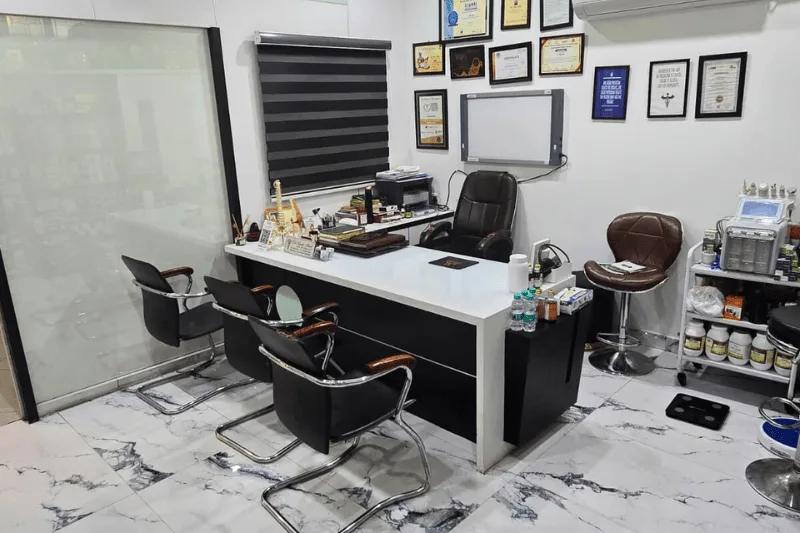
Images: “Flying through the sunrise” by Lenny K Photography, CC BY 2.0 (Wikimedia Commons, cropped and resized). The laptop photo is from the Dr. Abrol Ayurveda website image library. The consultation room photo is our own. Used for education; not photographs of patients at this hospital.
Medical disclaimer: This article is for education and does not replace a consultation with your doctor. Do not stop or change prescribed medicine on your own. Chest pain, fainting, vomiting or loose motions that will not stop, blood in vomit or stools, or a high fever needs urgent care at a hospital.
Have questions about your own symptoms?
Every case is different. Book a consultation with Dr. Abrol for a treatment plan personalised to your Prakriti and health history.
In This Article
- What Is the AYUSH Visa?
- Who Needs an AYUSH Visa, and Who Doesn't?
- e-AYUSH Visa or Regular AYUSH Visa: Which Route?
- Documents and the Hospital Letter
- Can Family Come With You? The Attendant Visa
- When to Apply: A Simple Timeline
- AYUSH Visa: Myths vs Facts
- Health Checks Before You Travel for Treatment
- A Typical Visa Question We Get
- Plan Your Ayurveda Treatment in India
- About the Author
- References
Book a Consultation
Get a personalised Ayurvedic treatment plan from Dr. Abrol - in clinic or online.
Dr. Amita Abrol
Gold Medalist BAMS, MS Gynaecology
Common Questions
Frequently Asked Questions
The e-Visa route asks you to apply at least 4 days before you travel, and you can apply up to 120 days ahead. A regular AYUSH visa through an Indian mission can take longer, because some missions need an in-person visit for biometrics. We suggest starting about 6 weeks before your flight, so there is time to collect the hospital letter and your records.
No. The official e-Visa page says e-Visas are non-extendable and non-convertible. So agree on the full length of your treatment with the doctor before you apply, and leave a few spare days. If you may need a longer stay, ask your Indian mission whether a regular AYUSH visa suits you better.
Choose the visa that matches the main reason for your trip. If treatment is the main reason, the official pages point to the AYUSH category, or the e-Visa for e-Ayush purpose. If you are unsure, ask the Indian embassy or consulate before you apply. Rules change, so check on the day you apply.
No. An OCI card lets you visit India without a separate visa, including for treatment. Do check that your OCI record shows your current passport. The Embassy of India in Washington says cardholders must update their OCI details each time a new passport is issued, and the update is done online.
It covers both. Indian missions ask for a prescription or medical history document for treatment, and note that this is not needed for wellness. So a Panchakarma course for general health can fall under it. You still need the supporting letter from the hospital or wellness centre that will treat you.
Up to two. Indian missions say not more than two persons, attendant or family member, may get the attendant visa at a time. On the e-Visa route, two e-Medical Attendant Visas can be granted against one patient visa. The patient and attendants are expected to leave India together.
Keep Reading
More on Ayurvedic Lifestyle

Ayurvedic Lifestyle
Read Article
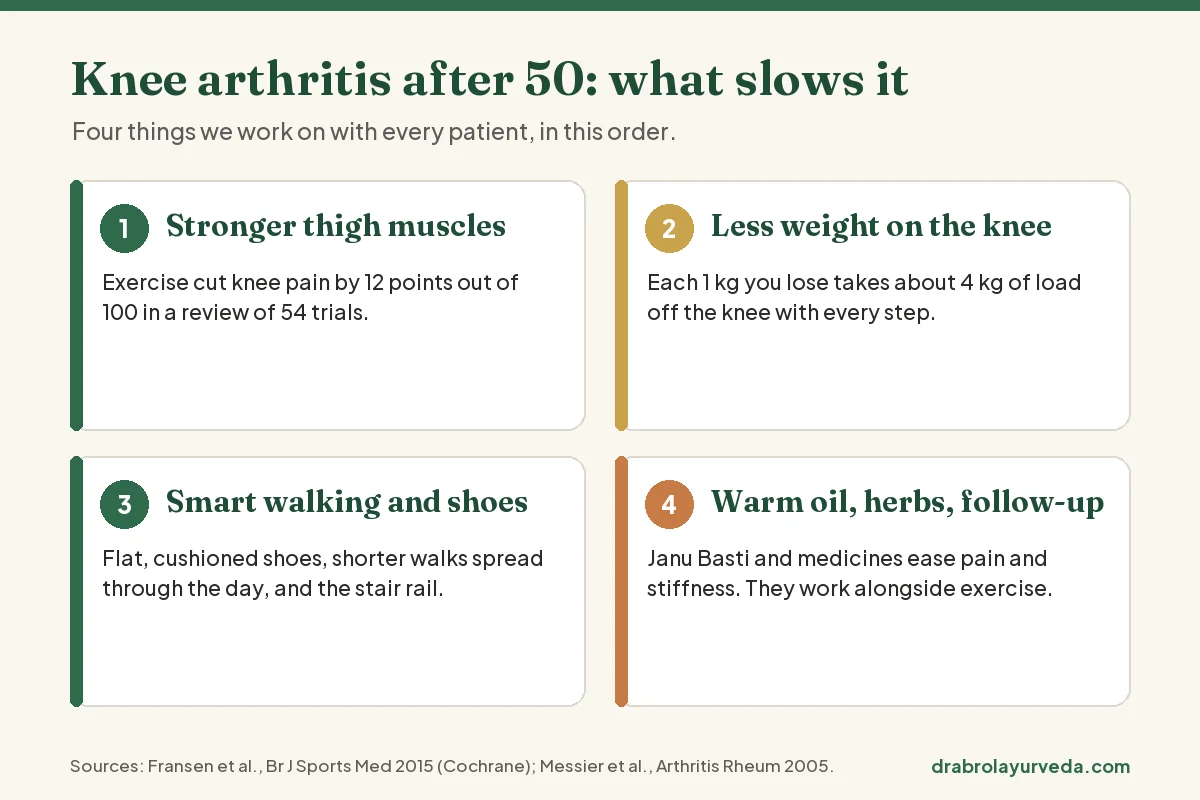
Knee Osteoarthritis After 50: What Actually Helps, and What Doesn't
Ready to Start Your Ayurvedic Healing Journey?
Book a clinic visit or online consultation with Dr. Abrol, based on what you've just read.